Author: D.Z., InkAndIron from Beijing SDSZ International Department
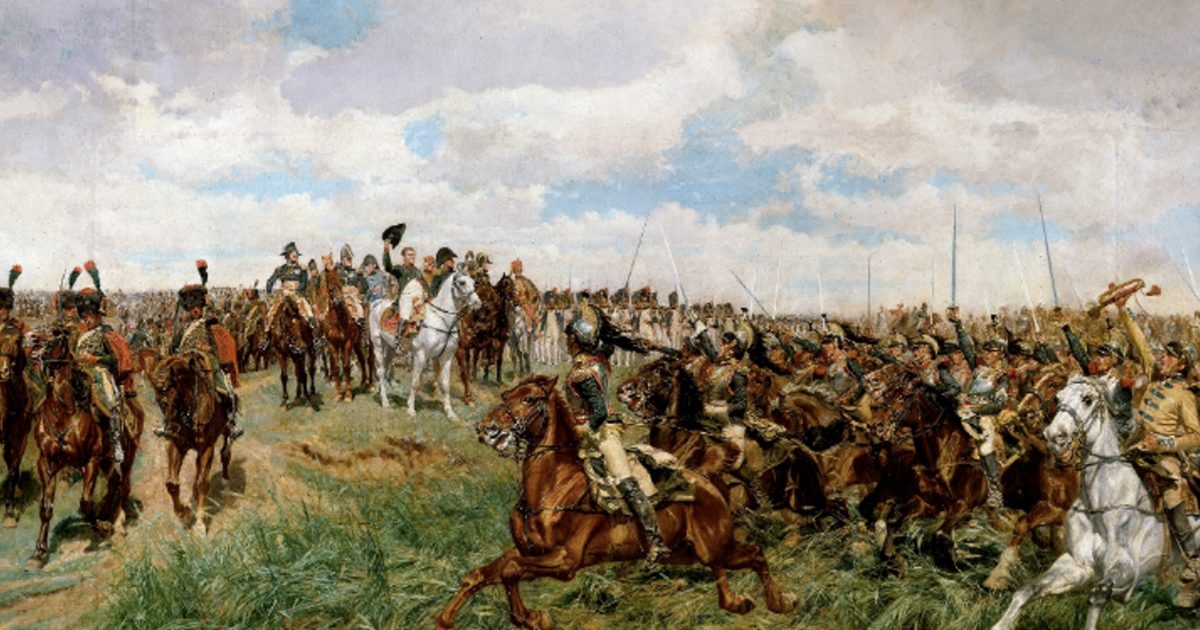
We fight when we disagree. It is a most basic instinct of human nature. To attempt to bend those who resist to our will. Yet what distinguishes war from primitive fighting is the fact that it is organized on a massive scale, a product of the machinery of states. It differs from instinctive and chaotic violence in that war is political, organized, and waged for a clear purpose. Yet despite the fact that wars and battles have been raging since antiquity, and despite the continuous improvement of our ability to kill each other ever more efficiently, the heart and mind of man is still behind the conduct of war (at least for now). Also, even though machine guns and tanks have replaced bows and chariots, the basic logic and principles of war remain essentially the same.
Let us first consider the definition of a war. As Prussian military theorist Carl von Clausewitz famously stated: “War is a continuation of state policy by other means,” and “War is thus an act of force to compel our enemy to do our will.” War is waged as an act of policy, to force a change of policy upon the enemy state/group, be it financial reparations, an indemnity, territorial concessions or annexation. This objective needs to be well defined. To wage war is, after all, a path either to victory and glory or to ruin. A rash charge into war for some vague uncertain purpose can only dampen the enthusiasm and undermine the efficiency of the armed forces and so compromise their fighting effect.
Nations invariably claim they wage a “just” war. That is why a casus belli is required: to provide legitimacy to the populace as well as to other powers in order to garner support, or at least secure neutrality. It is also essential in fostering domestic mobilization, and in ensuring a favorable post-war settlement. Since nations cannot cite the personal ambitions of some power-hungry monarch or dictator, they invoke historical destiny, or the collective will of the people, or cite some real or false grievance. But who cares why a war is waged as long as the cogs start to turn? It is the victor who writes the sequence of events, who creates history. As the Führer Adolf Hitler once put it, “The great masses of the people… will more easily fall victim to a big lie than to a small one”.
Mechanics of Battle & Firepower
Let us now see how battles work. The concept is simple enough yet must be understood. Multiple battles make up a campaign, and multiple make up a war. Battles are won by engaging the enemy with firearms or even in hand-to-hand combat and by destroying his will to fight through various factors, eventually forcing him to concede the field. It is a most bloody affair, and sometimes tests the mind more than it tests the army. Individual bravery can only work so much wonders.
Let us first discuss the most traditional defining factor: Firepower. However to be more precise, what truly matters is the cumulativeeffect of the firepower. Let us imagine two opposing lines of infantry facing at each other, man facing man. We shall call them A1 and B1. Both lines would soon be depleted due to rapidly mounting casualties. Yet consider this: if A1 and B1 are both two hundred soldiers long and forty deep, the front of each line can muster 200 muskets or rifles to fire at the enemy, yet the sides (or flanks) can at most bring to bear 40 without breaking formation. If another identical enemy line (let’s call it B2) should suddenly appear and pour flanking fire into A1 at a perpendicular angle, A1 come under fire from both sides with no effective way to retaliate, will suffer immense casualties within seconds, and be forced to retreat or simply break into groups of fleeing men. Such is the power of the flanking attack, yet it is in essentially a simple question of firepower, or application of force if you will.
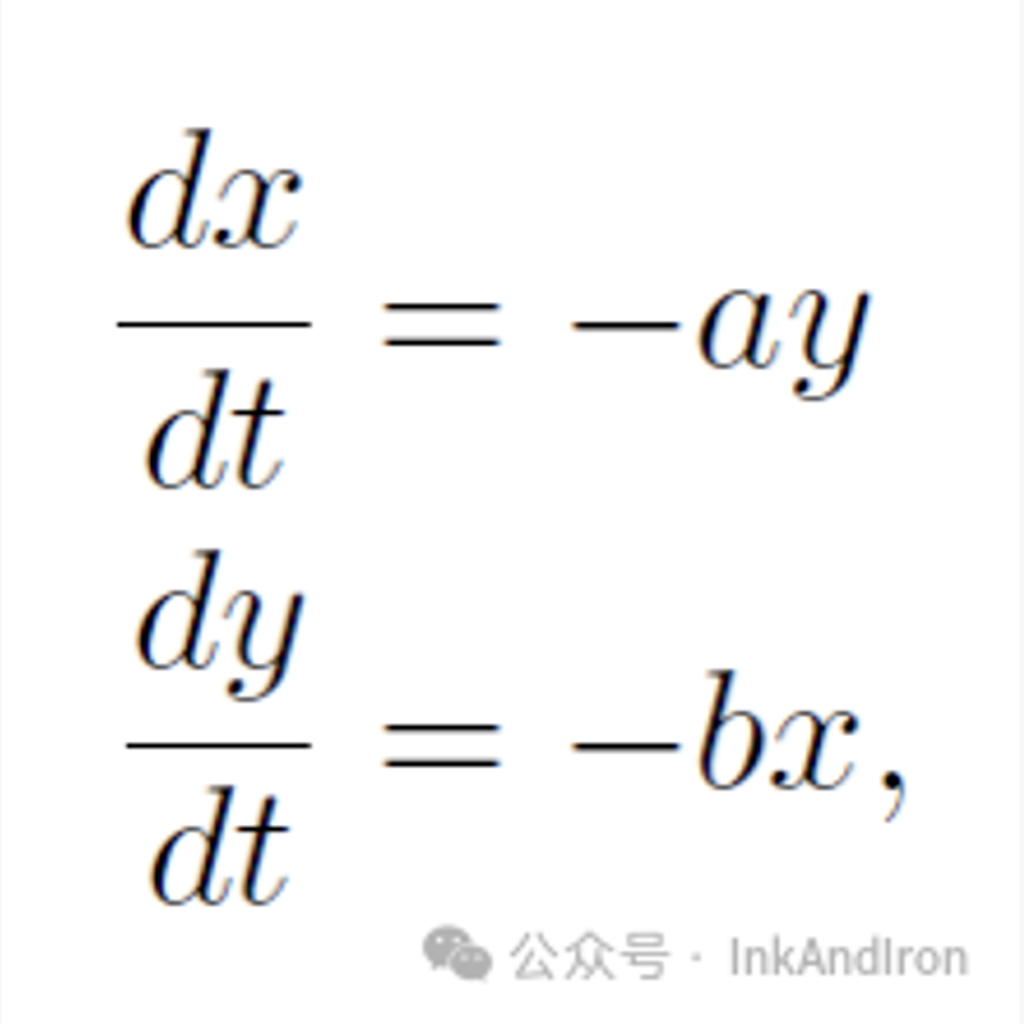
In fact, theorists have even quantified this dynamic with differential equations. Those interested can look up Lanchester’s Laws for further information. There is a “square law” which is most intriguing: it describes that the firepower ratio of two opposing enemy forces should the square of their numbers. Such is the effect of firearms compared to swords and arrows.
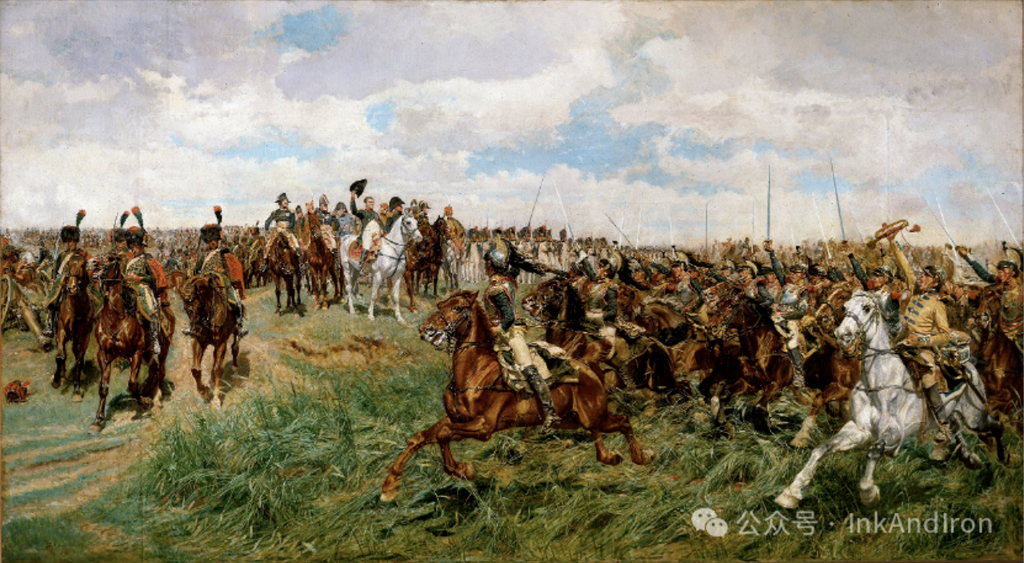
Yet another factor that must not be overlooked is the morale of the forces. Morale is influenced by a number of factors, including leadership, national cause, exhaustion, weather, hunger, and so forth. It is what motivates the soldier to fight, and thus must be taken with great seriousness. Napoleon once said: “In war, the moral is to the physical as three is to one.” Soldiers with low morale are likely to break and run after receiving a single volley of gunfire even if outnumbering the enemy, yet soldiers with high morale can mount a bayonet charge in the face of superior enemy fire despite withering losses and rout them off the field through sheer shock and awe. In other words, for trained soldiers or veterans, their training and experience directly translates into higher morale on the field, meaning that they do not easily break under pressure. Unit cohesion, an indicator of morale in the field, is far more durable among veterans than among raw conscripts. In a way, morale and training and sense of brotherhood among soldiers in the field is more important than firepower, as these determines who will be the first to break and run, regardless of casualties.
Fog of War and Operational Planning
But let us say war has been declared (and for the sake of argument the time is the mid 19th Century). The state machinery is set into motion. Reservists and conscripts are being called up, and start cohering into battalions, regiments, brigades, divisions (it is worth mentioning that the concept of nationwide conscription is in itself a relatively new one). The soldiers may be young men eager for the glory of battle, or they may be grim veterans who know what to expect. And in some dusty room, the High Command starts poring over maps and enemy intelligence to plan and direct movements. What now?
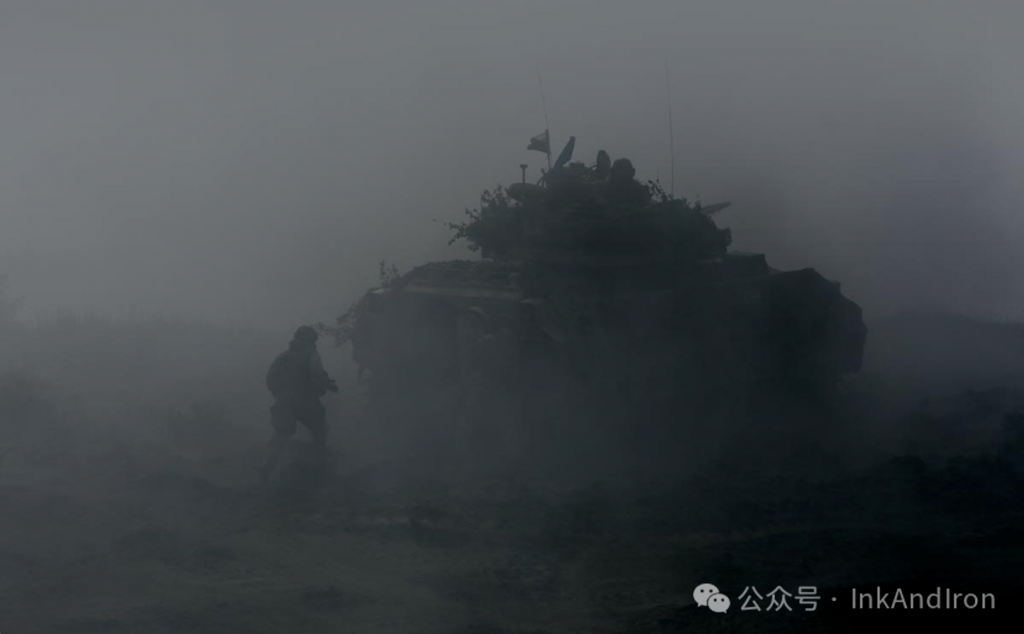
Well, first, let us consider a simple question. How should the army be directed? Perhaps towards the enemy capital to force a peace? Perhaps straight towards where the enemy main army is gathering to strike a blow? The thing is, waging a real war is vastly different from chess and board games, where you can at least see the situation in full. In the field, there is what Clausewitz termed the “fog of war”, which is just what it sounds like: a thick veil hiding the dispositions, movements, and plans of the enemy. In such a case, some cautious commanders will adopt a defensive strategy, moving very slowly and methodically, and attempting to probe out the enemy with cavalry. Yet this seldom leads to any good result and instead surrenders the initiative to the enemy. You cannot blame such figures too much though. For them, for any commander, defeat would mean disorganization, casualties, chaotic retreat, loss of army morale, and the very probable removal of the defeated commander from his post. It is so very hard to see through the fog. To make matters worse, some commanders have had the bad luck of having an inadequate staff, poor maps, and multiple political directives, forcing them to act with caution. Thankfully, by the age of our hypothetical scenario, armies facing each other have a good general idea of where the enemy is concentrating, if not their specific dispositions and plans. As for the axis of advance, objective and overall strategy, before we discuss how to plan them, one thing that must be stressed is that the objective, once hammered out, must be followed through. An army cannot march or fight while the main objective changes once the enemy is found or for any other reason. This will lead to administrative chaos and loss of valuable time.
Historically, armies have selected the enemy capital as their goal of operations. Yet even the capital can be given up for the sake of ultimate victory.
The Napoleonic Corps System, and the Importance of Flexibility
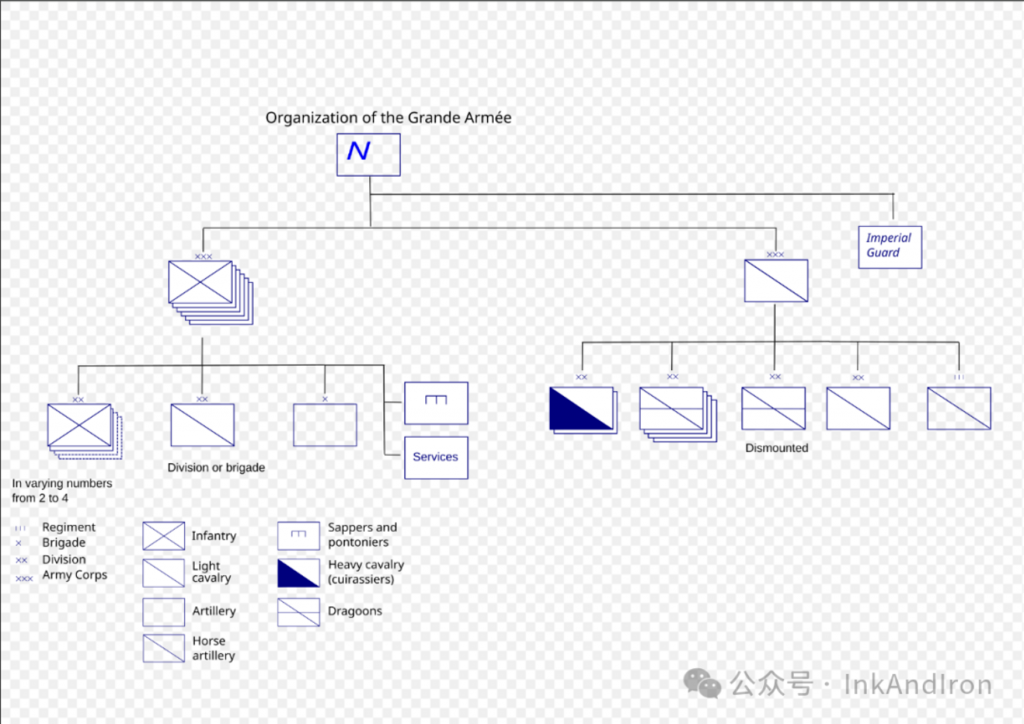
But now, let us consider how the army should be organized. It is a point of immense importance. In our age, population and manpower have not yet allowed armies to form an unbroken continuous front line on which to push. In that age, the standard unit was the division, of maybe 10,000 men, and the Army Corps, of maybe three to four divisions plus supporting artillery and cavalry. The Emperor Napoleon I created the corps system in 1805, and this system was a key component in his many victories. The corps system allowed each corps, commanded by a Marshal, to move as a mini-army of its own, living off the land and moving much faster and more flexibly than the other cumbersome armies of the age. Moreover, because it was a self-contained all-arms formation, it could hold off a much larger enemy formation without easily breaking. In this way, Napoleon could spread his corps (most famously he had seven in 1805) out in a screen but within supporting distance (typically one day’s march) of each other, while he led the large Cavalry Reserve and his Imperial Guard of elite units. When one corps met the enemy main force, the Emperor would rapidly issue orders for his other corps to concentrate for battle, and perhaps swing around the enemy flank and rear, forcing the enemy to retreat or react and redeploy, pushing it off balance. At the decisive moment, he would launch a ferocious attack on a single critical point with overwhelming numbers, perhaps even throwing in his Guard, breaking the enemy line and routing the enemy army off the field. Thus, he could virtually annihilate the enemy army with a single crushing victory and force the enemy state to sue for peace. This was his model of war. It worked so well that virtually all the armies of Europe and the world adopted his model, both in doctrine and organization.
A good reason this model worked so well was its incredibe flexiblity. A simple order could redesignate a corps from flank guard to the vanguard, or turn the reserve into flank protection, allowing the entire axis of advance to pivot as smoothly as if handling a pistol. Flexibility is essential for an army. In war, the situation can change as suddenly as a tsunami. Having a flexible mindset and a flexible army ready to pivot to any situation is paramount for war.
The Commander, or the General
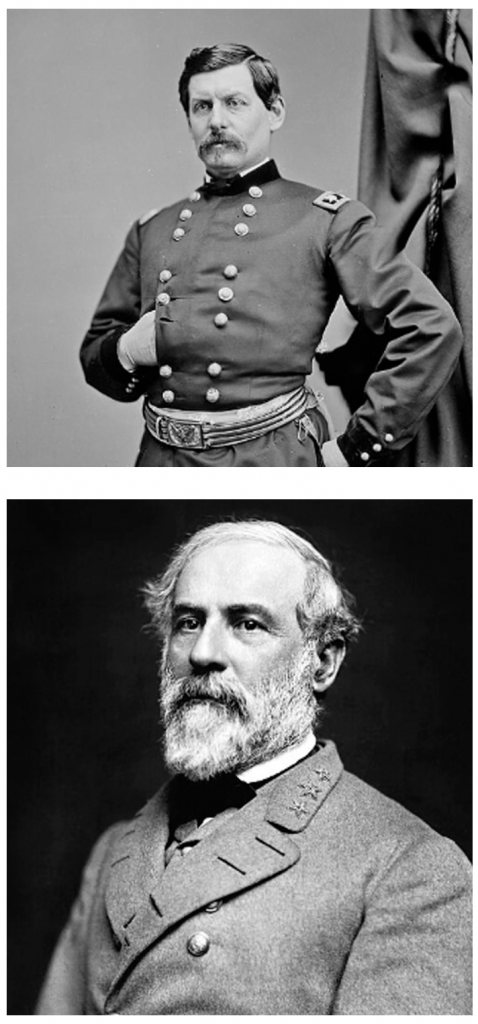
The commander is the heart of the army. He is responsible for directing its movements, preserving its safety, maintaining its morale, and leading it into battle with spirit and skill. Yet first and foremost, there must only be one commander for each formation. “Better one bad general than two good generals”, as Napoleon said. An army cannot fight under multiple minds since it would not remain one organic entity any more, and coordination would become a deadly issue. Since no two minds work alike, it could prove disastrous to have dual leadership against a smaller yet decisive and fast-moving foe. Above all, the commander must have the ability to instill a fighting spirit in the hearts of his men, inspire confidence, make them willing to march straight at the enemy, fire, and possibly be killed. A commander should lead from the front during battle, to boost the morale of his rank and file. He may even lead a charge to terrible effect. Though beware of musket-fire and cannon-shot.
Furthermore, since his job is to make the final decisions, the burden of achieving victory or suffering a defeat rests squarely upon his shoulders. Heavy is the hat of a general, yet he must not let it weigh him down. Many a battle or campaign has been lost due to the commanding officers dithering away their time in indecision, allowing the enemy to formulate a plan and put it into action. Being decisive is essential, be it to advance or retreat. Doing nothing is worse than either. One thing to note that war may seem simple, and in a way it is, yet even simple is difficult due to numerous factors of friction.
On Operational Maneuver
When you have a general idea of where the enemy main force is concentrated, you can now decide your objective. Suitable options include marching to cut the enemy’s supply lines, capital, sacking cities in order to lower popular support and gain resources. At all costs, your supply line must be maintained. If it is threatened, you shall have to turn back, because an army out of supply cannot wage war and will disintegrate. Men desert more often than you might think. Likewise, strike the enemy’s supply lines whenever possible to deprive him of resources. Concentrate your forces on his weak points and advance with speed to force an advantageous battle. Speed and mass are essential. I have always thought that the force of armies corresponds well to the equation F=m*v.
The destruction of the main enemy army should always be your main objective. Do NOT send your valuable units off on useless endeavors (unless perhaps to seize an undefended capital), but rather focus your efforts on the annihilation of the enemy main force, as if it is destroyed, all obstacles are removed, and the enemy state will likely sue for peace.
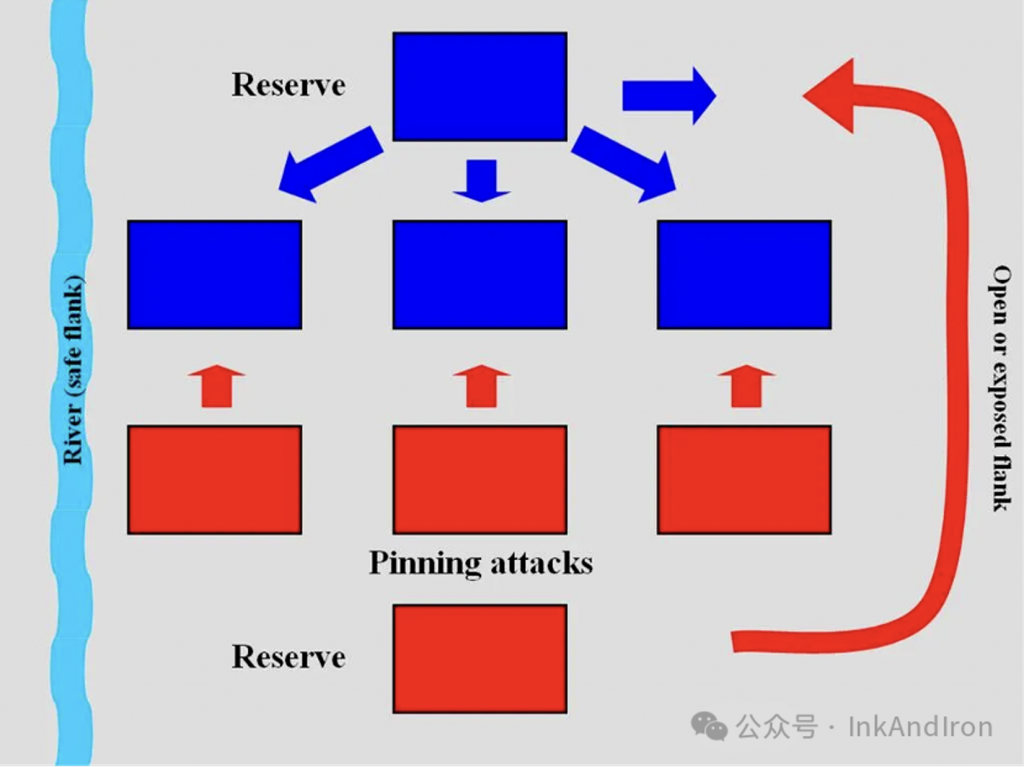
Remember the flanking attack? It also works on the operational level. A good idea is to screen or mask the enemy’s main force with cavalry or light units, while you concentrate all available forces to strike the enemy when he is weak and exposed. Use this concentrated strike to drive him off the field with heavy losses. An army has a balance, or “center of gravity”, and when this is disrupted it can affect the whole ability of the army to fight and coordinate. When the enemy is off-balance, it becomes easier to strike him, with more devastating effect.
A most important principle of war, some say the most important one which pertains to the actual fighting, is the principle of mass (or, concentration of force). If you have, for example, 30,000 men facing 50,000, you must endeavor to throw your entire, or at least an overwhelming amount of your weight in firepower against a portion of the enemy force, destroying it, and continuing on to the next one while he struggles to turn to meet this threat. Try to screen or lure away or pin down the enemy’s main strength with minor forces, while you march with speed towards a portion which you can be sure to crush with ease.
On Doing Battle
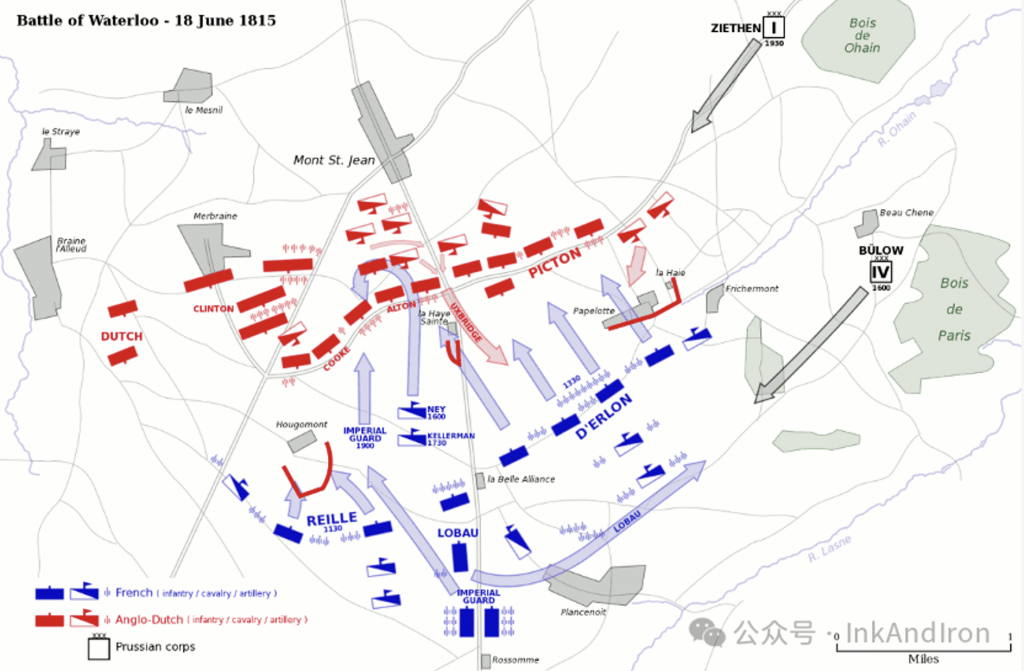
So you have found the enemy, or he has found you. You and your enemy counterpart ride towards the sound of the guns as more and more of your troops arrive to take part in the fighting. The first thing you should do now is take stock of the general situation and read reports from the front in order to figure out just how much enemy forces is opposite. Probe with light infantry and cavalry to see where the enemy lines ends and where his flanks are. As a general rule of deployment, place the artillery on elevated ground, infantry in the center, and cavalry on the flanks or as a reserve. What happens next will be left to fate and your devices. Normally, it will consist of a period where both sides use cannons to blast each other and move all troops into position, then one side will make the first move, mostly an infantry charge. Be sure to remember to use all three branches of the army in unison. Infantry is the backbone, light cavalry for harassment, heavy cavalry for shock charges, and artillery to pump cannister into the enemy ranks. A skilled general would direct them as a well-oiled machine, inflecting huge losses upon any attempted enemy attack, and launching a coordinated attack with cavalry and artillery support in turn against the weakest spot in the enemy line at the correct (some even describe it as the “psychological”) moment.
It is always desirable to move around the enemy flank and to strike him from the flank or rear. Besides holding a decided firepower advantage, the moral shock it brings can cause even the most experienced troops to flee in disarray. If a flank collapses from the shock of such a flanking assault, a “chain-rout” will likely follow, as units follow each other in fleeing off the field as the officers desperately try to rally them.
After a prolonged fight which may last most of the day (if it is a large engagement. Smaller ones may just last a few hours), one side will decide to retreat and give up the field. Victory is usually decided by which side holds the battlefield at the end of the battle. The victor may then rest his forces and detach cavalry in pursuit of the beaten enemy. The importance of the pursuit cannot be overstated, as this is the moment the enemy is most vulnerable, and a swift chase can bag hundreds, if not thousands of fleeing soldiers before they has a chance to regroup. Just be careful the pursuing force is not suddenly counter-attacked by a strong enemy force.
Note on the Modern Nature of Wars
The above mostly fits the Napoleonic Age up to the Civil War, but the face of warfare has changed beyond all recognition since then. New developments in rifle technology have, even by the age of the Civil War, deeply restricted the effect of horses, which were unable to stand against guns which fire at ever higher rates. Soon after, there came the Maxim gun, the Gatling, and a whole new generation of machine-guns which poured death into the ranks of any advancing infantry formation. This technological edge allowed the Western Powers to assert dominance over nearly any indigenous force they encountered. As the popular British saying goes “Whatever happens, we have got, the Maxim Gun, and they have not.” The development of air power has enabled aerial reconnaissance, and soon dogfights, and soon bombing. Artillery gradually became the king of the field as more and more powerful guns were created, enough to shred infantry, reduce fortresses to pieces, and shoot planes down from the skies. Yet some things remained familiar, like the enormous problems of supply that came with moving around and employing ever-growing armies, and the concept of concentration, speed, flanking, and so on. The devices producing firepower have changed, strengthened, yet the way of their employment have more or less remained the same.
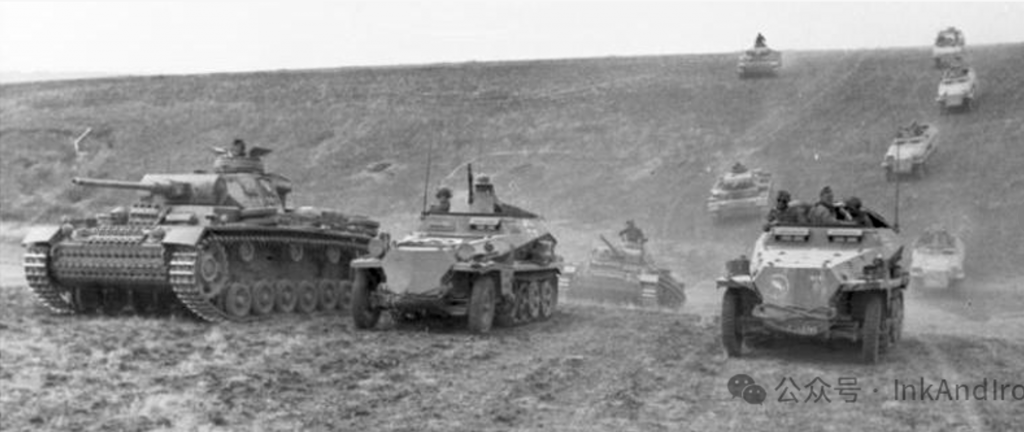
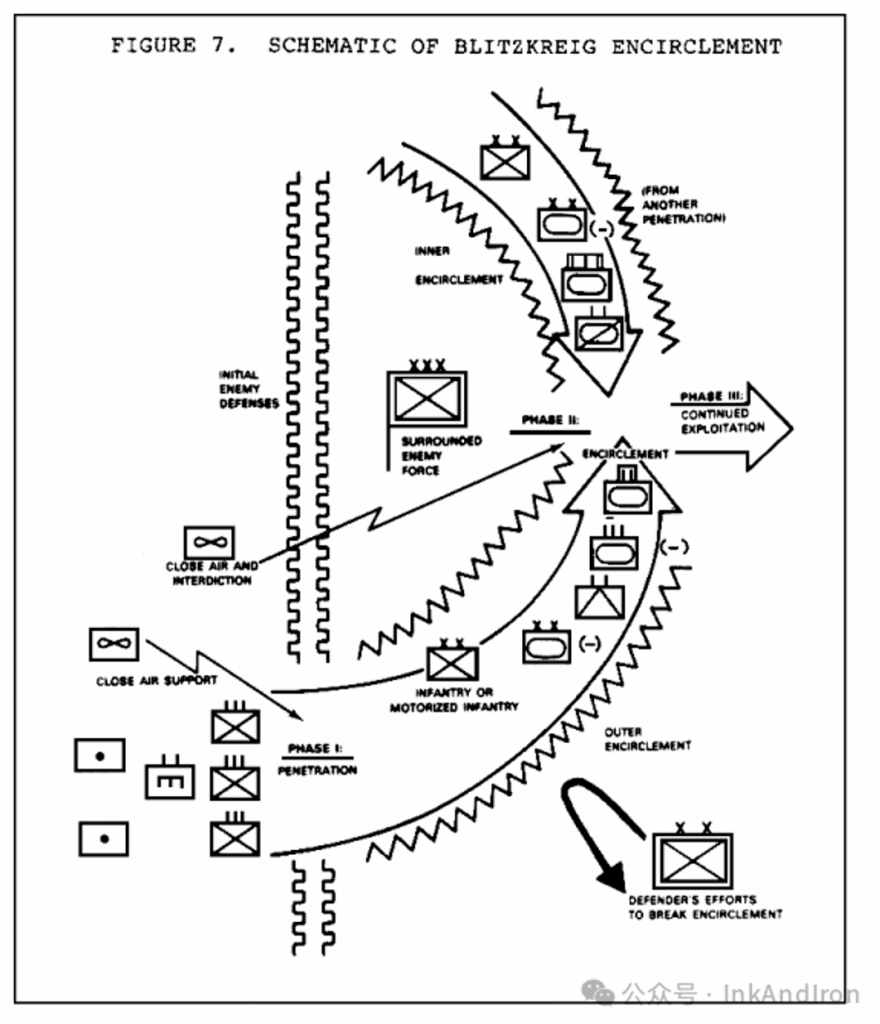
By the time of the First World War, infantry and artillery firepower had become so powerful that on the Western Front any assault against entrenched infantry met with enormous losses. Even the principle of concentration failed to achieve its desired effect, as the Germans learned at Verdun when they tried to “bleed France white” by massing an unprecedented amount of firepower in infantry and big guns, and received heavy casualties to no avail and eventual defeat. So people believed in the strength of such defensive systems, but by the start of WW2, indeed by the end of WW1, this was already changing due to a certain new innovation: tanks. Early tanks were prone to mechanical breakdowns, but by WW2, they were advanced and speedy enough to break through defensive lines straight into the enemy rear, wreaking havoc, and allowing newly motorized infantry to follow behind, mop up, and consolidate. When you pair this with screaming Stuka dive-bombers, fast radio communications, and talented tank commanders who dare to plunge deep into the enemy rear to rapidly encircle and destroy dazed enemy forces, you get a devastating new kind of war which used Poland as its first guinea-pig: Blitzkrieg, or lightning war. Does this new tactic have a weakness? Blitzkrieg relies on speed and momentum and breaking right through into the enemy rear. If you lessen the impact through multiple layers of defense, turn it into a war of attrition, then it can be contained. Also, as in previous forms of war, the use of combined-arms is important. Modern commanders use infantry, armor, air power, and nowadays even cyber-attacks in tandem to paralyze, attack, and destroy the enemy.
Conclusion
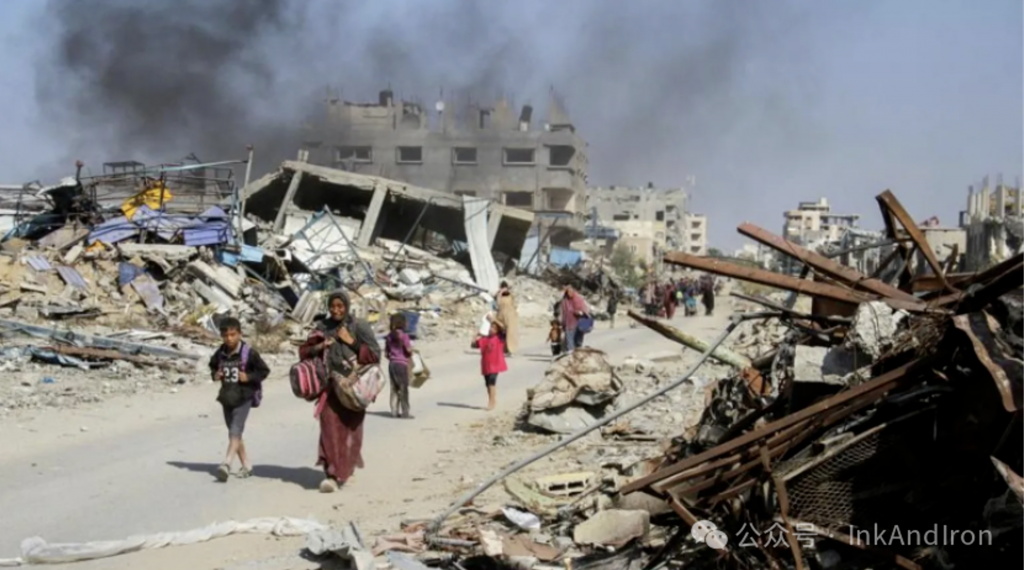
In conclusion, even though the face of warfare has changed beyond all recognition, the logic behind it has not. War is simply an instrument of the state, used to achieve a certain purpose through force of arms. It is constrained simply by the laws of nature and necessity, not by any laws of man. Since the goal is victory, it is acceptable to gain it at whatever cost, as nothing is worse than the breakdown and shame of defeat. This is not meant to be a treatise about the ethics of war, yet I will point out I support nations adhering to the Geneva Conventions and not mistreating POWs (prisoners of war). Not that France obeyed it in the Algerian War, but the Conventions do serve to contain the sheer brutality of armed conflict. Yet war is cruelty and you cannot refine it. It is a living hell, as the survivors of either world war can tell. Why is it fought with the utmost force and disregard for suffering? In theory, in order to force a swift peace. Yet when the great statesmen and generals play their game of thrones, it is always the populace that suffers the most. Truly, we should look to an age when war ceases to exist, yet it does not seem to be happening anytime soon.
Works Used:
Encyclopedia of Military Science, edited by G. Kurt Piehler
Leadership in War, Andrew Roberts
Military Strategy: A Global History, Jeremy Black
On War, Carl von Clausewitz
Strategy, Liddell Hart
New Principles of War, Marvin Pokrant
The Utility of Force, Rupert Smith