Author:Yusuf Wang 王悠粟
Abstract. Beijing has a long history of Islam, which has gone through the Yuan, Ming, Qing, Republic of China, and has been thoroughly indigenized in all aspects of Islam and Muslim life. This paper explores the characteristics of Islamic architecture, educational system, couplets and plaques, temple collections, cultural education, and other aspects in Beijing, excavates the characteristic of indigenization of Islam in Beijing and proposes methods and strategies for religious indigenization from the dimensions of cultural integration, social exchange, and development and inheritance. This research is helpful to protect and inherit cultural heritage, enhance social inclusiveness and harmony under different cultural backgrounds, reduce cultural conflicts and social contradictions, and provide support for achieving cultural diversity and sustainable social development.
Keywords: Islam, Beijing Mosque, Cultural Integration, Religious indigenization
1. Introduction
1.1. Research background
Islam is one of the world religions founded by Muhammad in the early 7th century in the Arabian Peninsula. Beijing is the capital of China, the world-renowned ancient capital of the Six Dynasties and historical and cultural city, after Jin, Yuan, Ming, Qing, Bei yang governments and new China. According to historical records, the earliest mosque in Beijing was the Niu Jie Mosque which was first built in the second year of Zhi dao in the Northern Song Dynasty. The integration of Islam and Beijing culture is mainly reflected in five aspects: architectural features, educational system, couplets and plaques, cultural relics and historical sites, and Islamic education. At the beginning of the 10th century AD, Islam was gradually introduced to Beijing from Central Asia, West Asia, and the Indo-China Peninsula. The Niu Jie Mosque is considered one of the earliest mosque courtyards in Beijing, founded in 996 AD (the 13th year of Emperor Sheng Zong of Liao). After the establishment of the Ming Dynasty, the Zhu regime implemented policies of ethnic tolerance and religious reconciliation. While repairing the mosques built during the Liao and Yuan dynasties, it also built four new mosques, such as the Hua Shi Mosque. The Qing Dynasty (1644-1910) was a period of rapid development of Islam in Beijing. During the period from Shunzhi to Guangxu in the Qing Dynasty (1640-1900 AD), more than 30 mosques were successively built in Beijing. In 1948, there were 46 mosques in the Beijing area, and by 2012, the number had increased to 70. Currently, there are a total of 71 registered mosques in Beijing. [1] The integration of Islam and Beijing culture reflects the strong inclusiveness and assimilation of Chinese culture, as well as the adaptability of Islam itself.
1.2. Research significance
In his article “Five Paths of Sinicization of Islam”, Li Lin introduced the methods of localizing Islam in China, elaborating in detail from five aspects: political identity, social status, religious system, clerical personnel, and ideology and culture, which initially laid the foundation for the study of the path of Sinicization of Islam. [2] The integration of religion and local culture is a complex and diverse process, involving the mutual exchange and integration of different religious beliefs and local cultural traditions. However, there is currently a lack of theoretical research on strategies and methods for the integration of religion and local culture. This paper takes Beijing Islam as an example to introduce the ways of localizing and integrating Islam in Beijing, and proposes methods and strategies for localizing religion. This study can enrich the theoretical research on the integration of religion and local culture, and explore the relevant issues of its theory and practice. At the same time, it can also promote the integration of religion and local culture, find commonalities between religious beliefs and local culture, achieve harmonious coexistence between religion and local culture, and have a positive effect on social harmony and cultural diversity.
2. Characteristics of Indigenization and Integration of Islam in Beijing
2.1. Architectural features
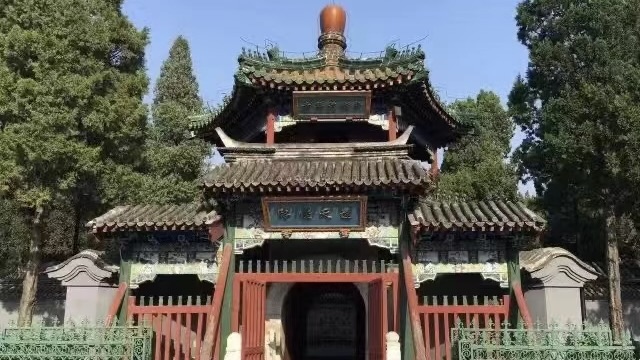
Architectural features refer to the special style of the era or region in which the building is located, including the appearance, structure, internal design functions, cultural connotations, etc. The characteristic of Islamic architecture is to abide by the norms of Islamic faith, with the main building being the mosque hall, facing towards the direction of the Mecca heavenly chamber, and the decorative species must not contain any animals or birds. The architectural features of Beijing are mainly quadrangle courtyards, with rigorous layout and exquisite design. Each quadrangle courtyard has its own “central axis” perfectly symmetrical. [3] The unique feature of Islamic venues (mosques) in Beijing is the fusion of Chinese civilization and Arab Islamic civilization. Mosques retain the traditional aesthetic of Chinese architecture, which are all Chinese quadrangle courtyards with obvious central axis features. Some mosques use shadow walls, [2] which have strong characteristics of ancient Chinese architecture; At the same time, the mosque also exhibits the characteristics of Islam. According to Islamic rules, there are no animals or beasts in the architectural decoration of the mosque. The screen wall is decorated with verses from the Quran, and the decoration of the long corridor mostly uses geometric patterns and verses from the Quran. These verses are all written in Arabic calligraphy using traditional Chinese brushes, and are written very round, reflecting the characteristics of the mosque’s Islamic religious activity site and complementing the features of Chinese architecture.
2.2. Academic system
The academic system refers to the specific procedures and operational processes of religious rituals determined through internal consensus. In the process of integrating Islamic culture with Chinese culture, it has formed the system of religious community, community contracts, and the system of Niyah.
First of all, the formation of the religious community system. The popular branch of Islam adopts the “religious community system”, which is very prevalent in some Muslim settlements in Hezhou, Gansu and Xining, Qinghai. The religious community system refers to dividing the organization of a mosque into two parts, one is the academic affairs group and the other is the temple affairs group. Each mosque is not subordinate to each other, and generally one religious community is formed around a mosque, forming an independent religious community. The religious community system was formed to meet the actual needs of Muslims living in scattered and mixed communities throughout the country. In history, it has played a certain role in promoting the spread and development of Islam in China and the formation of the Hui ethnic group, while also promoting the development of the mosque courtyard economy. [4] The “religious community system” is a system produced for better self-management under the instruction of the supreme ruler. It integrates centralized management of Chinese culture and is a Chinese style management in the Islamic community formed by Arab culture. This system improves the handling of internal relationships within Islam and promotes the development of various sects.
During the reign of Emperor Yongzheng, the rulers of the Qing Dynasty extensively promoted the community contracts in the northwest region in order to strengthen their control over Muslims. The meaning of “community contracts” is that the head of a township guarantees and supervises the behavior and activities of Muslims in the religious community to prevent the occurrence of prohibited activities. It was initially carried out in the He Zhou area of Gansu Province during the Yongzheng reign, and later extended to Muslim settlements in the northwest region. Afterwards, this community contracts developed into temple contracts and Hui contracts. It is mostly held by high-ranking officials with power and influence. At the lower level, there are village elders assisting with general tasks, such as managing the property of the mosque, resolving disputes among the people in the church, and organizing various religious activities. Although they are not members of faculty, they are gradually gaining real power within the religious community. This system promoted the internal management system of early Islam, and Islam gradually began to self-govern, self- restrain, and enhance the autonomy of Muslim community management.
Chinese mosques rely on the income from “Niyah” as a source of income for the operation of the mosque and the livelihood of the imam. The way to obtain “Niyah” is not through the Niyah box in the mosque, but through voluntary donations from Muslims after inviting the imam to recite the scriptures. In the Islamic world, the role of Niyah is not emphasized as much as in Chinese Islam, and more emphasis is placed on “Zakat”, one of the five major practices of Muslims, which is donations. After Islam was introduced to China, the use of ‘Niyah’ as a donation from Muslims to mosques and imams became an important way for mosques to operate. The emergence of the ‘Niyah’ has enabled Chinese Islam to explore a unique business model, finding a path of self-sufficiency in countries where the whole people are not religious and ensuring the independence of Islam in China.
2.3. Couplets and plaques
Couplets and plaques are traditional Chinese cultural and artistic forms, which have a deep relationship with the orderly square Chinese characters used by Chinese people for a long time. Chinese mosque couplets and plaques are characterized by their rich Islamic culture and Chinese Muslim ethnic style. As a special product of the organic combination of Islamic culture and traditional Chinese culture, they play an important role in Chinese couplets and plaques. It should be noted that the vast majority of couplets and plaques only appear in Hui mosques [5]. The integration of Chinese Islam and local culture is mainly reflected in the characteristics of legitimacy and legality on couplets and plaques, that is, Chinese Islam originated from the Western Regions and inherited the legitimacy of Islam, as well as the legitimacy reflected in plaques about emperors and monarchs throughout history. In terms of the legitimacy of the former, the “Shuai you Jiu Zhang” at the Niu Jie Mosque in Beijing is an excellent example, emphasizing the idea that Islam comes from the Western Regions and follows the teachings and laws of the orthodox Islamic sect for religious activities. In terms of legitimacy, there is a “Shang Yu Pavilion” in the courtyard of the Hua Shi Mosque in Beijing, which is an imperial edict issued in the seventh year of the Yongzheng reign of the Qing Dynasty to protect the Hui people, reflecting its legitimacy. The hanging of these couplets and plaques in the Beijing Mosque not only reflects that Islam in China comes from the Western Regions, but also receives recognition from the highest local rulers, continuously consolidating and improving the social status of Islam in the local society.
2.4. Temple Collection Cultural Relics
The cultural relics in the collections of Beijing mosques are mainly divided into several types: handwritten manuscripts of the Quran, Islamic scriptures, ceramic crafts, bronze ware, stone carvings, rubbings, and inscriptions, all of which reflect the combination of Islam and Chinese culture. There is a handwritten manuscript of the Quran at the Dong Si Mosque in Beijing, which was written in 1318 by a man named Muhammad Handwritten by the Imam of Sara.[6] The entire Quran is written in traditional Chinese small regular script, which is elegant, skilled, and agile. Due to the long-term circulation of Arabic in China, writing Arabic scriptures in the form of Chinese calligraphy and hanging them in mosques and Muslim homes is a major creation of Chinese Muslims. Many Muslim heads of state take pride in being able to see this scripture during their visits to China. Not only handwritten manuscript of the Quran, but also ceramic crafts can reflect the integration of Islam and local culture. Chinese porcelain, which was founded in the Shang Dynasty, is an important contribution made by the Chinese to the history of world civilization. In the 11th century, Chinese porcelain making technology was spread to Persia, and then to the Arab region. The ceramic handicrafts in Beijing mosques are mostly works from the Ming and Qing dynasties, which have distinct Chinese craftsmanship and Islamic cultural characteristics. The “Blue and White Open Light Arabic Tripod Tube Furnace” hidden in the Niu Jie Worship Temple is a work from the Zheng de period of the Ming Dynasty. The furnace has three Arabic open lights on its body, which are translated as “Allah is in charge of grades”, “Allah is in charge of contentment”, and “Allah is the best of the good”. In short, the integration of Islam and Chinese culture is richly reflected in the cultural relics. The existence of the temple’s cultural relics not only reflects the historical connection between Islam and Chinese culture, but also reflects the unique influence of Islam’s dissemination and development in China.
2.5. Classic Education
Quran education refers to the educational form in which Chinese Muslims spread Islam in mosques and Islamic institutes. The depth of Islamic education in Beijing reflects the integration of Islam and local culture. In terms of the form of Quran education, Beijing mosques mainly adopted Islamic scripture hall education from the Ming Dynasty to the 1950s. This is a unique form created by Chinese Muslims to incorporate the concept of “private schools” in Chinese culture into the cultivation of Islamic talents. On the eve of the Xin Hai Revolution, the ideas of “saving the country through education” and “saving the country through science” were very popular among intellectuals, and new-style schools had already appeared. In 1907, Imam Wang Kuan founded a new type of Halal Normal School in the Niu Jie Mosque, which was the first modern Islamic educational institution in China. Wang Kuan boldly carried out teaching reforms, changing the backward situation of traditional “temple affiliated scripture learning, outdated and clumsy teaching methods, cumbersome and ineffective teaching, and traditional academies”. In terms of the content of Quran education, in addition to continuing to offer the existing Islamic teaching courses, Arabic and Chinese language courses such as reading the classics, composition, and conversation have been added.[7] The curriculum includes both Islamic and Sinology; There are both Islamic courses and cultural topics aimed at equipping students in modern schools with the ability to adapt to the trends of the times. In 1908, Wang Kuan founded the Second Grade (junior and senior) Primary School of mosque in the backyard of Niu Jie Mosque, which was the first Islamic primary school in Chinese history specifically designed for Muslim children. The mosque’s second-class primary school is known as the “cradle of Beijing’s new-style schools”. In 1949, with the establishment of the People’s Republic of China, the People’s Government took over Beijing Cheng Da Normal School, Northwest Middle School, and Yan Shan Middle School, and founded the National Hui Muslim College. On this basis, an Arabic language specialized course was established. In 1955, the China Islamic Studies Institute was established on the basis of the Arabic language specialized course. The China Islamic Studies Institute offers religious courses, cultural courses, and professional courses in a ratio of 7:2:1.[8] Among these courses, ‘Selected Texts of Chinese Islamic History’ has become a compulsory course for freshmen to seniors at the China Islamic Studies Institute.
3. Methods and strategies for religious indigenization
3.1. Strengthen the integration of Islamic classics and local culture
Strengthening the integration of Islamic classics and local culture can help enrich cultural connotations, expand the diversity of local culture, and enhance the indigenization of religion. The first is to understand the local cultural needs. Deeply understand the diversity of local culture, including values, moral norms, religious beliefs, humanistic traditions, etc., comprehend the historical roots, formation and evolution process of local culture, and explore the core values in local culture that are in fit with Islamic. The second is to understand and integrate the cultural ideas of Islamic. Sort out the origin, development, and inheritance of Islamic cultural thought, integrate the core principles and local cultural characteristics of Islamic thought, provide explanations that are in line with the progress of the times, innovate and adapt to the needs of modern society, and explore the possibilities and ways of integrating Islamic thought with local culture. The third is to promote policy support and social participation. By formulating relevant policies, providing financial support, establishing research projects to support and encourage the integration of Islamic classics and local culture in research and practice, the inheritance and development of Islamic classics are guaranteed; Organize lectures on Islamic classics and culture, community cultural activities, and encourage active social participation in cultural inheritance and integration activities. In summary, strengthening the integration of Islamic classics and local culture requires long-term efforts to promote it. It is necessary to respect tradition while facing the future and exploring and innovating cultural values that meet the needs of modern social development.
3.2. Promote communication between religious organizations and local society
Promoting communication between religious organizations and local society helps to enhance social understanding of religion and facilitate its integration into the local community. Firstly, strengthen open dialogue. Religious groups should hold academic activities in different forms to conduct academic discussions and research on the history and culture of their own religion; Open religious sites to the public for visits, promote public understanding of religion, and eliminate misunderstandings; Regularly organize joint activities with other religions to promote exchanges between religions. Secondly, strengthen cultural exchanges. Organize cultural exchange activities, establish connections with people from all walks of life through public welfare charity and knowledge lectures, encourage exchanges between different religious groups and members of society, and promote social understanding and tolerance of religion. Finally, strengthen cooperation and support. In terms of public welfare and charity, religious organizations should cooperate with institutions from all walks of life, carry out cooperative projects, and help solve social problems such as poverty and education; Various sectors of society can provide venues, funding, and other support for religious activities to achieve two-way cooperation. To sum up, promoting communication and cooperation between religious organizations and local society can enhance mutual understanding and trust, and jointly promote the development and prosperity of society.
3.3. Ensure the development of religious education and the inheritance of religion
Effectively promoting the development and inheritance of religious education, ensuring the continuation of religious traditions, and adapting to the needs of modern society. First, improve the religious education system. To promote the consolidation of undergraduate and master’s education foundations in national religious colleges, explore the models and methods of doctoral education, and form a comprehensive education system with undergraduate, master’s, and doctoral degrees; Give full play to the main channel role of Islamic colleges and design a comprehensive religious education curriculum that adapts to the development of The Times. Second, develop modern religious education. By utilizing modern educational technology, respecting and understanding religious traditions, adapting to the needs of contemporary society, reflecting multicultural and inclusive values, integrating new academic research results into religious education curriculum, ensuring accuracy and foresight of content, and improving student participation and learning outcomes. Third is to strive to cultivate “dual understanding” talents. Strengthen the training of teachers in religious colleges to ensure that they possess profound religious knowledge and cross-cultural communication skills, and can adapt to the constantly changing educational needs; Efforts will be made to run national religious colleges well, improve talent training plans, comprehensively enhance the level of education, and implement training measures. In short, ensuring the development and inheritance of religious education can better accelerate the indigenization process of religion and promote social harmony and stability.
4. Conclusions
Islam, as one of the three major religions in the world, has been introduced to China for over one thousand years. Islam in Beijing originated in the Liao Dynasty and has continued to this day. Over the course of more than a thousand years, Islam and Chinese culture has continuously exchanged and blended, ultimately achieving indigenization in China. The integration of religion and local culture is a complex and lengthy process. Islam in Beijing has absorbed the ideas of Chinese architectural culture in terms of architectural features. In the process of building mosques ( places for religious activities ), it takes traditional Chinese architecture as a sample and absorbs certain elements of Arab Islamic culture; In terms of educational system, obey the government’s management and establish a unique teaching workshop system with Chinese characteristics; In the artistic decoration of mosques, especially on couplets and plaques, Chinese calligraphy and idioms from Chinese are used to explain Islamic teachings; In the collection of cultural relics in the temple, representative of Chinese cultural characteristics such as porcelain and calligraphy, Islamic style decoration and artistic expression are integrated into it; In the field of Islamic education, the traditional Chinese concept of “private schools” has been applied to cultivate Islamic talents, creating a distinctive ” Masjid-E-Noorul Islam ” model with Chinese characteristics. Strengthening the integration of Islamic classics and local culture, continuously promoting exchanges between religious organizations and local society, and effectively ensuring the development of religious education to promote religious inheritance, is the historical experience of indigenization Islam in Beijing. In summary, religion faces difficulties and challenges in its development and dissemination in any region. Only by combining religion with regional history and culture and promoting its dissemination can religion be better developed and social harmony and stability be promoted.
References
- Huiqian Ding. Mosques in the urban and Guanxiang areas of Beijing during the Ming and Qing dynasties. Journal of Hui Muslim Minority Studies,No.01, Vol.25, pp.32-39, 2015.
- Lin Li.The Five Paths of Sinicization of Islam. The World Religious Cultures,No.03, pp.107-115, 2020.
- Xun Tong. The Formation and Development of Mosque Culture in Beijing. China Muslim,No.03, pp.4, 2004.
- Jingjing Wang. The Characteristics of Sinicization of Islam: Taking the Gedimism as an Example. Youth Literator, No.12, pp.198+200, 2012.
- Xiulin He. The Sinicization Characteristics of Mosque Couplets. China Muslim,No.04, pp.28-30, 2018.
- The ancient books and cultural relics of Beijing Dongsi Mosque have been sorted out and completed. http://iwr.cass.cn/xw/201608/t20160809_3417130.shtml
- Traditional Sutra Classroom Education Textbook Thirteen Classics Textbook (Introduction). https://mp.weixin.qq.com/s?__biz=MzI1ODcyNDUxNw==&mid=2247485688&idx=2&sn=a23ae69d508acaf94f2ad9305d2565f2&chksm=ea028f32dd750624ed9b2d865edace786ed29df339114f0ebc749c1a0927ef4d803a475567f2&scene=27
- Top 10 Islamic Studies Institutes in China. https://mp.weixin.qq.com/s?__biz=MzAxNDExMjg5NA==&mid=2718089623&idx=3&sn=52818880831c81d69ad66273c95b9f62&chksm=bc6e20868b19a990ec8c9b70825df
The picture is from the Internet. If there is any infringement, we will delete it immediately.