
Author: Ink and Iron, Beijing SDSZ International Department
Prelude
After the signing of the Treaty of Shanyuan (1005 CE) and Li Deming’s “submission,” the Song Dynasty entered an era of peace. Though minor border conflicts persisted, no large-scale wars erupted for over two decades. During this period, the Song court preoccupied itself with grand religious ceremonies (“Eastern Fengshan and Western Sacrifices”), leaving national strength stagnant. Meanwhile, Western Xia (Xixia) expanded westward, conquering the Uyghurs and Zongge tribes, steadily growing in power. Through the efforts of Li Deming and his son Li Yuanhao, the Tangut people controlled the entire Hexi Corridor, establishing an empire with a bureaucracy, written language, and territory stretching from the Yellow River east to Yumen Pass west, Xiaoguan south to the deserts north. If not now, when would the Song strike?
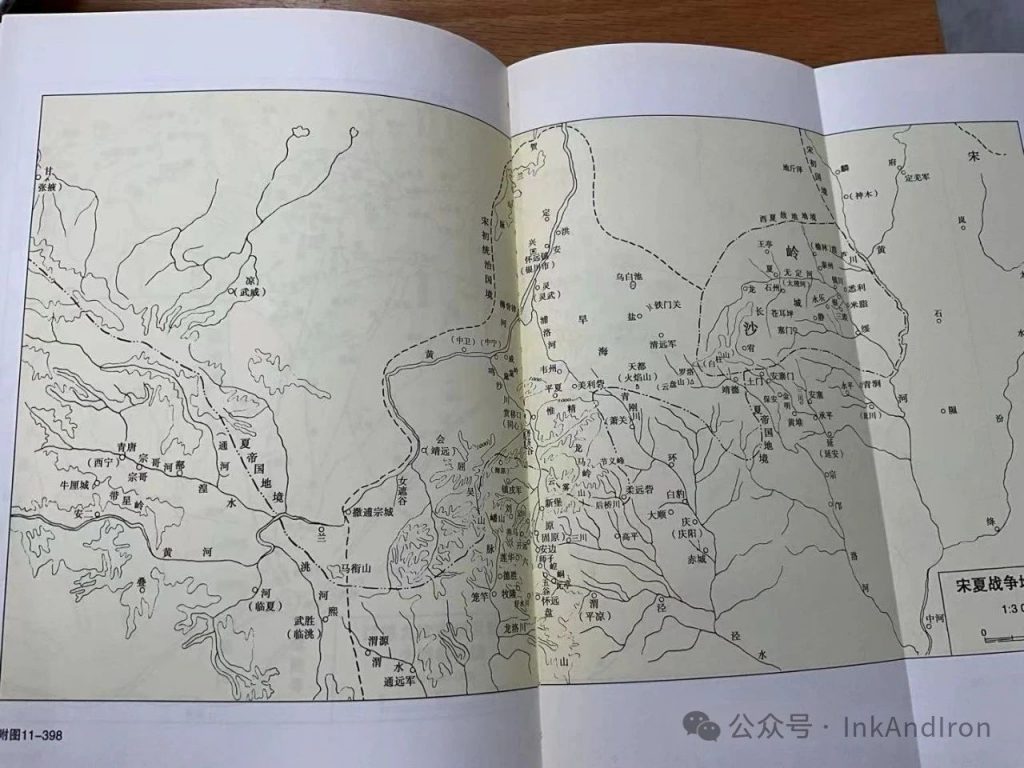
The Song-Xia border comprised four military circuits:
- Qinfeng (Wei River basin)
- Jingyuan (Jing River & Huluchuan basin)
- Huanqing (Maling River basin)
- Fuyan (Yan River & Luo River basin)
Of these, Huanqing Circuit (modern Gansu) and Jingyuan Circuit (Gansu’s Jingchuan and Guyuan) formed the strategic heartland of Song-Xia conflicts—a battlefield for over a century.
The Battle Unfolds
In 1038 CE, Yuanhao declared himself emperor. Song officials debated invading Xia. Despite the Song’s militarily disadvantaged position in Shaanxi, hawks dominated the court. As Deputy Military Commissioner Liu Ping of Fuyan-Huanqing Circuit proclaimed:
“Yuanhao rebels, slaughtering at will… his people betray him. Heaven has ordained his downfall! We cannot underestimate this foe nor let him grow stronger. If we divide 200,000 elite troops from Qinfeng, Jingyuan, Huanqing, and Fuyan into two columns… we outnumber Yuanhao threefold… He is but a fugitive bandit beyond the river!”
—Continuation of Zizhi Tongjian, Vol. 42
Such was the Song court’s confidence.
The Turning Point
After Yuanhao annihilated 10,000 Song troops under Guo Zun and Liu Ping at the Battle of Sanchuankou (January 1040), the Song took notice. By August, Han Qi (Jingyuan Circuit commander) urged Emperor Renzong to mobilize all four northwestern circuits for a decisive invasion of Xia territory: “Xia remains a minor state. Destroying tens of thousands of its elite will pacify the frontier.”
Conversely, Fan Zhongyan (Fuyan Circuit commander) argued:
“Our forces cannot yet engage Xia in open battle. Secure border cities, clear the countryside, and deny them decisive engagements—dare they invade deeply?”
With no consensus reached by February 1041, Yuanhao launched a full-scale invasion of Jingyuan Circuit—forcing the Song to fight defensively on home soil.
The Trap at Haoshuchuan
Learning of Yuanhao’s 100,000-strong march toward Weizhou, Han Qi:
- Sent Zhenrong Army to intercept
- Ordered General Ren Fu to ambush 20,000 troops at Yangmulong Fortress—a narrow pass vital for Xia’s retreat route.
Han Qi’s command:
“Advance from Huaiyuan to Deshengzhai→Yangmulong Fortress. The 40-li route offers easy supply. If battle seems unwise, fortify the pass and ambush their retreat. Intercept them on return. Violate these orders, and even victory warrants death.”
—Continuation of Zizhi Tongjian, Vol. 43
The plan was sound—but Ren Fu disobeyed.
Disaster Strikes
Ren Fu camped at Huaiyuan City. After scouts clashed with Xia troops at Zhangjiabao, the Xia feigned retreat southward. Song vanguard Sang Yi pursued; Ren Fu followed with his main force, abandoning supplies. By dusk, Song forces split:
- Ren Fu camped at Haoshuchuan
- Zhu Guan and Wu Ying at Longluochuan (5 li apart)
Exhausted and undersupplied, Ren Fu marched 40 li overnight to Haoshuchuan Pass by dawn. There, they found a sealed box. Upon opening it, 100+ whistling pigeons burst out—signaling Xia ambushes from surrounding hills. The Song army was surrounded.
The Massacre
Sang Yi’s cavalry charged west—slaughtered. Xia flankers attacked from the south. Song troops scaling northern ridges fell into traps, tumbling down cliffs as commanders died. When urged to flee, Ren Fu declared:
“A general does not flee defeat. I repay my country with death!”
—Song Shi (History of Song)
He fought until “a dozen arrows pierced him, a spear tore his cheek, and his throat was cut.” Ren Fu’s army perished.
Meanwhile, General Wang Gui arrived at Yangmulong with 4,500 reinforcements. Learning of the disaster, he knelt eastward and cried:
“I betray not my country—only my strength fails! Death alone repays my duty!”
—Song Shi: Biography of Wang Gui
He charged into Xia lines:
“Killed scores, his iron whip bending, palms split. Three horses shot beneath him, he slew dozens more until an arrow took his eye.”
On the opposite ridge, Zhu Guan and Wu Ying awaited allies at the pass. After crushing Ren Fu, Yuanhao encircled them. By dusk, Song defenses collapsed—only Zhu Guan and 1,000 men survived behind a ruined wall until reinforcements came.
Aftermath
In a single day:
- 200+ officers including Ren Fu, Sang Yi, Wu Ying, and Wang Gui fell
- 10,000+ Song troops died
- Jingyuan Circuit’s forces shattered, ending Song offensive capabilities
Conclusion
Early Renzong-era Song military strength had declined: Imperial Guards no longer matched Taizu/Taizong-era elites, while northwestern armies remained underdeveloped. Even Taizong’s seasoned troops failed to crush the fledgling Tangut state—Renzong’s defeat was foreseeable.
Beyond troop quality, the battle exposed systemic flaws:
- Political Inefficiency: Six months (Aug 1040–Feb 1041) wasted due to divided command (Fan vs. Han) and unclear authority. The historical note “議未決” (deliberations unresolved) hides rivers of frontier blood.
- Military Tactics: Losing the Hengshan-Tiandushan line left Song unable to establish forward defense. Elastic defense (concentrating forces to annihilate enemies) required two conditions Song lacked:
- Sufficient field armies
- Unified command
Success in elastic defense came only later at Hongdecheng (1092) and Pingxiacheng (1098).
Despite defeat, the Song soldiers’ valor endured. As Song Shi concludes:
“At Haoshuchuan, generals died fighting. Yes, Ren Fu erred chasing glory—but upholding righteousness unto death? That marks true heroes!”
Annotations
[1] History of Chinese Warfare errs: Ren Fu marched from Zhenrong Army, not Weizhou.
[2] Following Song Shi: Biography of Wang Gui—Wang charged to rescue Ren Fu.
References
- Continuation of Zizhi Tongjian, Vol. 42–43
- Expanding the Northwest Frontier (拓边西北)
- History of Chinese Warfare, Vol. 11
- Song Shi: Biography of Wang Gui
(This historical analysis was edited by Peter Tian of UHHC Operations Office. Images sourced online will be removed upon copyright request.)