Author:Michelle Zhu, Independent Member of UHHC
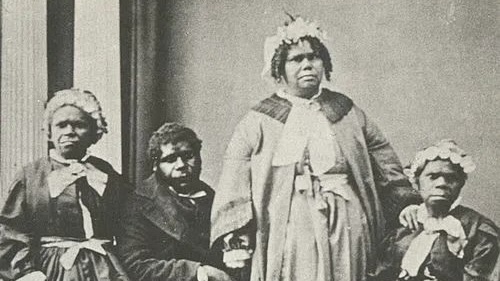
(The Topmost Image: Last four Tasmanian Aboriginal, 1860s, Truganini is on the right side)
Part I: The Last Days of Truganini
The air in Hobart clung thick with salt and dampness, the kind that seeped into old bones and stayed. Truganini sat hunched by the small window of the cottage, her hands—gnarled like the roots of the melaleuca trees she once knew—pressing against skin grown paper-thin over eighty winters. The fire spat and gasped, fighting the chill, but no flame could reach the cold that lived inside her now.
“Pugganah,” she whispered—enough. The word curled like smoke in the air.
Mrs. Dandridge was startled at the sound. She was a kind woman, a settler who tended to Truganini with an affection that was not unkind but still foreign. “Hush now,” she whispered, as one might soothe a fretful child. “No one will harm you.”
“No cut me up,” Truganini murmured again, her voice a dry whisper, as if the wind might steal her words before they could be heard. “Lay me on the pyre. Let the wind take my raytji—my ashes—to the sea.”
The settler woman’s fingers fussed with the blanket. “The doctors say—”
But Truganini’s black eyes saw the lie for what it was. She had seen too much to believe in promises.
“Mina!” Truganini’s knuckles whitened on the chair. No. The old fire surged, just for a heartbeat. “You tunnerminnerwaithe—you promise me!”
Silence dragged on. The ghost of a wattlebird’s call drifted through the glass, and Mrs. Dandridge looked away.
The D’Entrecasteaux Channel glimmered in the distance, the water restless under the grey sky—larapuna, the old ones had called it. Once, Truganini had swum there as a girl, the waves lifting her like they knew her. Once, she had gathered shellfish with her mother, the sand warm beneath her feet. Now, the sea was a thing she could see but never touch again.
“When I go,” she pronounced, slow and deliberate, “you must burn me. You must let the wind take me.”
Mrs. Dandridge hesitated. “The doctors—”
“No doctors!” The force of the words startled even Truganini. She sagged back into the chair, her breath uneven. “No… more… knives.”
A tear traced the deep grooves of her face. They had measured her skull, those men of science. Written down her words like specimens pinned to a board. But they would never understand the weight of memory—how the land lived inside her, even now.
“Tiraweke,” she murmured to the waves. I am still here.
The gull’s cry sliced through the air again—krak-krak-krak—like the sound of a digging stick striking bone. It was the same sound the soldiers’ boots made on the shale when they took the tribe’s children away.
Truganini closed her eyes. In the darkness, she saw the faces of those she had lost. Her mother, taken by the sickness. Her sisters, gone in the violence. Woorrady, her husband, his body broken by the white man’s long knives. And the others—the ones whose names she whispered at night, the ones whose blood still stained the earth of this stolen island. She would join them soon.
But not in the way she wished.
Part II: The Bones That Remember
1. The Death Watch (May 1876)
The candle guttered in its pool of wax, throwing shadows like grasping fingers across the walls. Mrs. Dandridge clutched Truganini’s limp hand—the skin papery, the knuckles like mountain ranges under her fingers.
“Pupina,” Truganini had whispered that morning, her breath sour with the metallic tang of dying. The restless ones are coming.
Now, in the silence after her last breath, the wind rattled the windowpane. It carried the salt of the D’Entrecasteaux Channel, the scent of melaleuca leaves crushed underfoot, and the distant cry of a tayaritja eagle circling high above.
Mrs. Dandridge prayed silently. Then, with hands that trembled, she reached for the bell to summon the doctor.
They buried her in the convict cemetery at night.
Truganini’s spirit hovered above the grave, watching as the priest mumbled words she didn’t know over a body she no longer recognized. The coffin was made of cheap pine, already warping into the damp earth.
“Burn me,” she whispered again, but the wind snatched the words away.
Mrs. Dandridge stiffly stood to one side, her hands clasped tight. When the men began shoveling dirt onto the coffin, she turned away and walked back to town.
The moonlight cast long shadows across the unmarked grave. Somewhere in the darkness, a tayaritja eagle screamed.
2. The Theft (1878)
The grave was shallow.
It had to be—after all, Truganini had been buried in the convict cemetery, not in the hallowed ground of a church. The men worked quickly, their shovels biting into the damp earth with wet, rhythmic thunks.
“Careful with the skull,” hissed the curator from the Royal Society. His spectacles gleamed in the lantern light. “The cranium must be intact for measurement.”
Truganini’s spirit wailed as the shovels bit into the earth, but the men didn’t hear. They laughed as they worked, their breath fogging in the predawn chill.
“Careful with the pelvis,” snapped another Royal Society man.
When they lifted the coffin lid, the stench of damp rot and quicklime rose like a sigh. The curator leaned in, his breath fogging in the cold air. Her body was still wrapped in the thin shroud Mrs. Dandridge had provided. The flesh had mostly rotted away, but her hair—which used to be thick and black in life—still clung to the skull in matted clumps.
“Remarkable,” he murmured, brushing dirt from the hollow orbits of her eyes. His thumb lingered where her laugh lines had been. “Note the pronounced supraorbital ridge,” he said to his assistant.
One of the gravediggers marked it down.
“She belongs to science now,” he whispered. To himself or the howling spirit, nobody knows.
They took her bones away in a canvas sack.
3. The Glass Prison (1904, Tasmanian Museum)
For forty-three years, she stood in the corner of the Natural History wing. Truganini’s spirit paced the confines of her prison, screaming every day at the passersby visitors until her voice cracked. No one heard anything.
“Mum, is she real?” A child’s finger left a smudge on the glass.
“Hush. Don’t touch.” The mother pulled the boy away. “She’s just an exhibit.”
Truganini’s bones gleamed under the electric lights, wired together with meticulous cruelty. The placard beneath her feet shone mockingly:
TRUGANINI (c. 1812–May 1876). THE LAST TASMANIAN ABORIGINAL.
Outside, the wind howled around the museum’s stone walls—the same wind that should have carried her ashes to larapuna, to the deep waters where purinina whales sang.
Now she is nothing but a specimen. A curiosity. The Last Tasmanian.
4. The Liberation (April 1976)
A century too late, they finally set her free.
Truganini’s spirit watched as the activists—her people’s grandchildren—unwrapped her bones from the museum’s velvet-lined boxes. An elder whispered in their language as he brushed the dust from the skull’s hollow eyes.
“Time to go home, sister.”
On the shores of the D’Entrecasteaux Channel, they built a pyre of saltwood and eucalyptus. The flames burned blue at the edges, hot enough to finally erase the touch of the scientists’ hands.
As the ashes rose on the wind, Truganini felt the pull of the tide at last.
“Tiraweke,” she whispered—I am still here—but now it was a song, not a plea.
The wind carried her out over the water, where the purinina whales breached in greeting.
Some say if you stand there at dusk, when the tide is coming in, you can hear two voices in the waves—one old, one young—singing the song of Bruny Island. And, if you press your ear to a conch shell on that shore, you’ll hear more than the ocean—you’ll hear the echo of a song older than museums, older than bones.
“Tiraweke. We never left.”
(Edited by Peter Tian from UHHC,All rights reserved by the author.)