Anonymous, Zeitgeist: An Open Quarterly for Ethics and Human Values
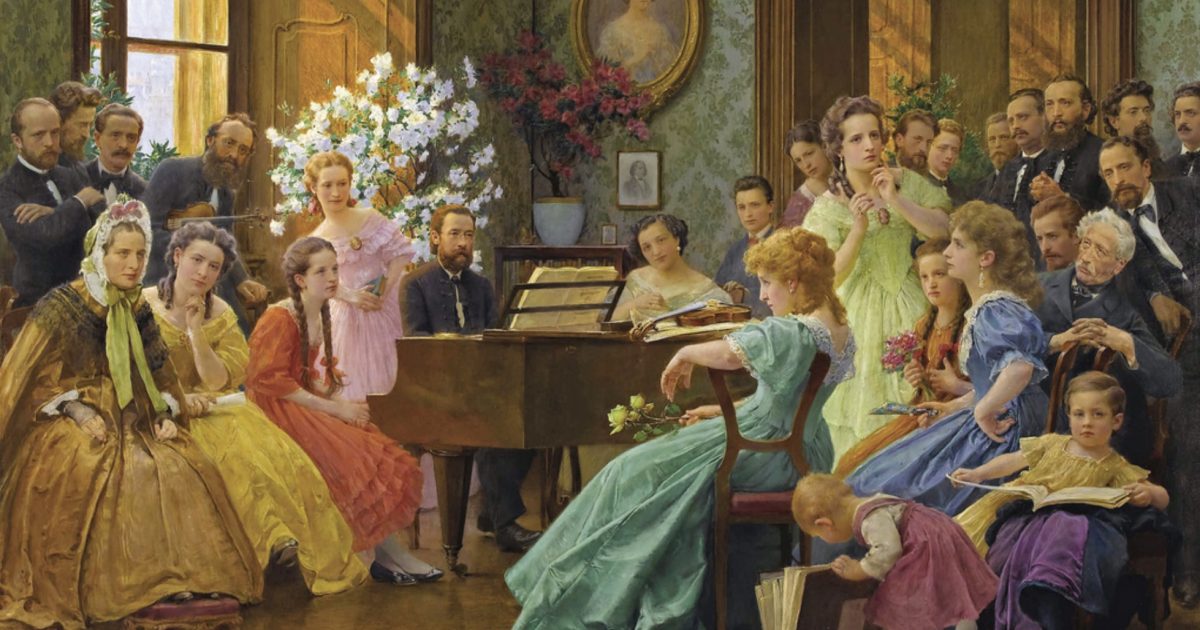
(Top Image: Bedřich Smetana Among his Friends, 1865; oil painting by František Dvořák)
Introduction
What makes a nation is the past; what justifies one nation against others is the past 1. Music as the combination of cultural, linguistic, and religious memories of nations actively preserves and invents collective awareness of nationalism for the population. Western art music since the Nineteenth Century has been deeply reshaped by the expanding influence of nationalism. Musical nationalism quickly develops and spreads over the continent over the century, which leads the Twentieth Century into the inevitable passage of catastrophic warfare. This essay will explain how Western art music in the Nineteenth Century was impacted by the ideology of nationalism, the power of musical nationalism, and how it changed the course of history by thrusting the continent toward irreversible passage.
Music and Nationalism
Musical Nationalism is defined in “The New Harvard Dictionary of Music” as “the use in art music of materials that are identifiably national or religious characters” which might include folk music, and non-musical programmatic elements drawn from national folklore, myth, or literature 2. It is not difficult to identify geographical distinctions when comparing the music of different nations, which derives from the inseparable linkage between music and its linguistic originality. Music, an “intertextual linguistic construct 3”, must have been greatly influenced by the natural rhythm and syntax of the local language in the development of characteristic cadences 4. Even Wolfgang Amadeus Mozart varies his composition of opera in German and Italian distinctively. Although the composer speaks fluent Italian, he adapts his German opera to local folk songs, the Singspiel, with a more comical and less formal composition, compared to his Italian work.
Nationalism is a dynamic process of cultural identification with a nation and national qualities 5. All strong feelings of anguish, solemn, or sorrow, are facilitated by the reciprocal influence of collective excitement, and therefore act as socializing factors. Artistic production is the most natural result of strong feelings; thus it is a social activity in its innermost nature 4. The production of music is inseparable from the social and political circumstances at the time. Nationalism is therefore an inevitable musical subconsciousness, which actively impacts and reconstructs the contour of musical composition. The bourgeois nationalism of the nineteenth century was a pan-European phenomenon 6, which was an acknowledged force in music at the time 7.
Early in 1905, Bartók began collecting folk songs in Hungary, which integrated peasant idioms within contemporary art music 8. When scrutinizing musical nationalism, the context of political nationalism is indispensable, so as to determine whether there were any correlations between the condition of political nationalism and musical culture 9. When the Cologne project in Germany elevated the Rhine Province as a potent symbol of nationhood, the Rhenish Romantic nationalism reached its apogee which resulted in the remarkable outpouring of Rhinelieder in the 1840s 10.
German nationalism was embodied in renowned art music, such as Schumann’s “Rhenish” symphony, and Wagner’s tetralogy, Der Ring des Nibelungen, both dedicated to the Franco-Germanic border area, Rhineland. Wagner’s opera tetralogy was conceived explicitly as an indictment of the contemporary social order when the flame of revolution spread across Europe at the time of 1848 11. Comparably, born in the time of political tension and mounting nationalism in Poland, Chopin devoted a significant proportion of his work to his motherland through composing and performing a great number of ‘Polonaises’ and ‘Mazurkas’ in his lifetime. Both two genres are based on regional folk dances, which are composed of vivid Polish national characteristics.
The fusion of art and folk music marks the first canonic repertory of European nationalism 10, which registered a ceded privileged understanding of the traditional repertory based on nationality in Europe 12.
Significance of Music in the Spreading of Nationalism
Music since the early stage of the Romantic Era has been greatly influenced and reshaped by nationalism. The ideology became an inseparable determinant of European music in the nineteenth century, spreading popularity, and interweaving with the development of art music over time. Arthur Schopenhauer concluded music as a form of aesthetic, which owns the qualities of “stimulating” and “charming” 13. It is a form of art that possesses the capacity of imitation and the manifestation of human feelings, such as sorrow, despair, and joy, throughout variations of dynamics, tonalities, and articulations, for instance, allegro maestoso corresponds to grand, noble, and striving atmosphere, which is possibly a product of imagination of spectators.
The imagined expressive agents have a great tendency to evoke emotional responses from the audiences and cause the spectator to imitate the artist’s feelings. Thus the musician helps the material-minded audience to share his feelings and idealism momentarily for the imaginative 4.
Several composers were able to insert and spread nationalism in their musical work, which made the ideology more prevalent through the medium of music which impresses the audiences to a greater extent and evokes a more significant emotional response. Wittgenstein remarks that “understanding a sentence is more akin to understanding a theme in music than one may think 14”. The analogy drawn between music and language might suggest that music possesses emotional content as language has its conceptual content 14.
Music is a powerful agent of spreading nationalism for its supremacy in comparison with literature. In the nineteenth century, nationalism often spread through poetry, pamphlets, and other forms of literary work; however, music attained its superiority over linguistic devices, for it matched the form of human feelings more closely 15. The flow of sound and rhythm removes linguistic boundaries, and evinces general understanding of the work since the expressive agents arouse emotions without requiring any contextual reference to extra-musical reality 16. The quality inspires a wider range of audiences and extends the sphere of influence of nationalism across the nations, as speculators become more vulnerable to the ideology under the power of nationalistic music.
Since music is a composition of various notes and rhythms, it is almost impossible to determine certain meanings for a piece of music, but alternatively, a range of interpretations, for instance, both outbursts of fury and ecstasy might be represented by loud dynamics, which elicits vagueness. The ambiguity of music determines that it serves as an “unconsummated symbol 17”, which is inexplicable, finding no equivalents in linguistic alternatives. During the expansion of nationalism across Europe in the nineteenth century, symbols play a major role in the cultivation of a sense of solidarity among the members of a group 18.
Under the influence of nationalism, art music includes elements of folk music and becomes a cultural symbol of each nation, that actively cultivates and promotes the sense of belonging and self-identification to one specific nation among the population. In the late nineteenth century, nationalism and music had accomplished a rather complete and throughout blend. Nationalist musicians composed aesthetic works based on folk songs. Famous Czech composer, Bedrich Smetana, admitted to preferring libretti based on Czech history since they would “contribute most to the establishment of a national operatic style 19.” Most of his operas are based on historical and legendary material, for instance, The Brandenburgers in Bohemia deal with peasant resistance against a German occupation in the thirteenth century 11.
Musical nationalism not only influenced the composition of music but actively impacted other forms of aesthetic production. Smetana’s most significant set of works, the Má Vlast, employs rich depictions of specific Czech landscapes, including the Vltava River, woods, and meadows. The symphonic poem evokes a general national pride among the Czech people. Well-known Czech artist, Alphonse Mucha, was impressed by the musical nationalism and thereafter created the acclaimed artwork, the Slav Epic, dedicated to his homeland.
The Czech nationalistic movement is not the only evidence of music as a thriving power in the spread of nationalism in Europe between the nineteenth and twentieth centuries. Musical nationalism is an eminent stream of power in mounting nationalism among countries, which eventually led to growing tension over the continent and dragged towards the irreversible puddle of conflicts.
Nationalism in the Twentieth Century
As Europe entered the Twentieth Century with mounting nationalism spreading around the continent, the growth of tension seemed an unalterable state. Musical nationalism and other aesthetic productions had implanted the ideology pervasively into Europe, which gave the populace a sense of shared beliefs and attitudes regarding the processes and outcomes of international relations 20. Anderson defined nation as an “imagined political community”, and nationalism is the cultural artifacts that bonds and serves as basis of the emergence of national consciousness 21, which can potentially promote aggression 22.
Under the expanding influence of nationalism in the Twentieth Century, the masses may internalize the nationalist rhetoric, believing that their national identity, reputation, and self-rule are endangered by the inferior “others”, and can only survive through military action. The feverish ideology generates biased strategic assumptions, creates domestic interest groups that favor war, permits the suppression of opposition groups, and promotes ‘nationalist bidding wars’ 20.
The German “iron and rye” coalition prior to World War I embroiled the state in conflict by giving a fleet-building program to the industrialists, high agricultural tariffs to the aristocratic landowners, and an offensive war plan to the army. The first policy alienated Britain, the second angered grain-exporting Russia, and the last threatened all of Germany’s neighbors 22.
The mounting nationalism ultimately leads to the assassination of Archduke Franz Ferdinand, by a maniac Serbian nationalist. The assassination is arguably regarded as the event that changed the course of history. A majority of historians believe that it is the trigger of the Great War, as it evokes a chain of events by igniting the mounted tension between European countries. Since the Serbian government refused to hand in the conspirators to Austro-Hungary, the Habsburgs declared war on Serbia, regardless of the warning of Tsarist Russia. The conflicts between empires ultimately involved other European countries, all bonded with each other by treaties and alliances.
In comparison, the power of music seems insignificant; however, as a powerful source of nationalism, music implanted the ideology into the minds of the European populace, converting them into feverish supporters of interstate wars. The interlacing dynamics of imperialism and revolutionary nationalism formed the basis of empire-building and reconstruction, as well as laying the conditions for their ultimate destruction 24. It is undeniable that nationalism constructed the foundation for alienation and conflicts across Europe, and music over the 19th century played a significant role in the expansion of the ideology. Therefore musical nationalism has predetermined and altered the course of history since art music had begun to blend with nationalism.
Conclusion
Hayden White perceives historical narratives as “verbal fictions”, the contents of which are as much invented as found and the forms are more alike to literature than sciences 25. Since history is a choice of narrative, such ‘determining points’ are defined by observers of history instead of the events that happened in the past. The Sarajevo incident is perceived as the turning point of history for its particular time and location. The long-lasting impacts of nationalism are often overlooked as it is enduring and imperceptible. Similarly, music has cultivated a crucial ideology since the 19th century. Musical nationalism has constructed an irreversible passage for the European world to proceed. The course of history has been determined decades before the gunshot in Sarajevo in 1914.
Bibliography
References
[1] Hobsbawm, Eric J., and David J. Kertzer. “Ethnicity and nationalism in Europe today.” Anthropology Today 8, no. 1 (1992): 3–8.
[2] Randel, Don Michael, ed. The Harvard Dictionary of Music. Harvard University Press, 2003.
[3] Jenkins, Keith. Rethinking History. Routledge, 2003.
[4] Toye, Francis. “A Case for Musical Nationalism.” The Musical Quarterly 4, no. 1 (1918): 12–22.
[5] Gentry, Jonathan Caleb. Nationalism in Western Art Music. Oxford University Press, 2011.
[6] Dahlhaus, Carl. Nineteenth-Century Music. Vol. 5. University of California Press, 1989.
[7] Burkholder, James Peter, Donald Jay Grout, and Claude V. Palisca. A History of Western Music. New York: W. W. Norton, 2009.
[8] Brown, Julie. “Bartók, the Gypsies, and Hybridity in Music.” In Western Music and Its Others (2000): 119–142.
[9] Dahlhaus, Carl. Between Romanticism and Modernism. University of California Press, 1980.
[10] Samson, Jim. “Music and Nationalism: Five Historical Moments.” Ethnosymbolism (2007): 55.
[11] Curtis, Benjamin. Music Makes the Nation. Cambria Press.
[12] Bohlman, Philip Vilas. The Music of European Nationalism. 2004.
[13] Schopenhauer, Arthur. The World as Will and Representation. Aegitas, 2016.
[14] Wittgenstein, Ludwig. Philosophical Investigations. Blackwell, 1953.
[15] Langer, Susanne K. Philosophy in a New Key. Harvard University Press, 2009.
[16] Adorno, Theodor W. Introduction to the Sociology of Music. 1976.
[17] Meyer, Leonard B. Emotion and Meaning in Music. University of Chicago Press, 2008.
[18] Guibernau, Montserrat. Nationalisms. John Wiley & Sons, 2013.
[19] Séquardtová, Hana. Bedřich Smetana. Editio Supraphon, 1988.
[20] Schrock-Jacobson, Gretchen. “The Violent Consequences of the Nation.” Journal of Conflict Resolution 56, no. 5 (2012): 825–852.
[21] Anderson, Benedict. Imagined Communities. Routledge, 2020.
[22] Beattie, Alan. “Elie Kedourie’s Philosophical History.” Routledge, 2014.
[23] Feuchtwanger, Edgar. Imperial Germany 1850–1918. Routledge, 2002.
[24] Anievas, Alexander. “1914 in World Historical Perspective.” European Journal of International Relations 19, no. 4 (2013): 721–746.
[25] White, Hayden. “The Historical Text as Literary Artifact.” The History and Narrative Reader 1 (2001): 223.