
ID Mailbox, Cynthia
I
I have no deep connection with New York. My first impression of New York came from photographs of skyscrapers—that world surrounded by glass curtain walls, where elites in monochrome suits with serious expressions walked. They passed countless walls, their eyes showing not curiosity but a numb flatness, already knowing what kind of world surrounded them. So before I ever set foot in New York, I fantasised that one day I would have the chance to see this city, and even stay here, becoming the “elite” I dreamed of.
The second time I heard about New York was through the musical Hamilton. “In New York you can be a new man”—that was the caption I posted on my social media after arriving in New York. I didn’t want to turn its history into required knowledge, but the musical told the story of America’s founding through a light-hearted narrative, and so I remembered: in New York, that world across the ocean was very developed. That musical was the earliest American history I encountered, and its filmed version became an important work that pulled me back into the musical theatre world. LMM’s genius wasn’t something I grasped on my first viewing, and that was precisely what New York gave me: the New York I imagined in my mind was still too little.
When I realised my summer school was also right in New York City, I started looking forward to this trip from right after my midterms. Different vague images formed in my mind again: some from The Devil Wears Prada, where the protagonist moves through New York traffic in designer fashion; some from Taylor Swift’s songs mentioning that diamond-studded New York City; and also all sorts of exam points I’d come across, including MoMA, various cultural centres, and a literary text describing New York’s growing prosperity. So my mind began to wander. What kind of stories would I have at summer school?
I also remembered my recent “editor dream”—like a fashion editor in a movie, wearing that season’s brown trench coat, gold earrings, smiling and greeting everyone around her. I even thought about starting a new magazine here, similar to the public account I currently have—a unique magazine for people my age and peers. But that dream vanished like foam, fleeting. I knew I couldn’t commit more firmly to studying media in college; it seemed other subjects might suit me better. I also knew I should get on the right track, like the train to Poughkeepsie—slow but rolling forward on the rails.
And so these stories began my New York journey.
II
But New York’s story was different from what I had in mind.
Flying from California to New York, the hazy yellow sky enveloped me and my fears. The wildfire-induced weather issues over New York caused the plane to circle twice south of Chicago, making me constantly worry, “What if there’s an accident?” The crowd at the airport engulfed me again: last time it was Beijing, but this time I wasn’t part of the flow—I was the one being engulfed. Pigeons flew from the parking lot entrance into the baggage claim area; following them with my gaze, I saw people in colourful clothes, forming a colourful painting. Children trotted through the airport, adults focused intently on luggage tags, a few fans in Argentina jerseys held phones to their ears, and the smell of people overshadowed the bustle.
The taxi drove all the way to 125th Street—that was Harlem. Harlem, a neighbourhood that had lived in my old TOEFL listening practice materials, now appeared before me as a real entity. Emerald-green murals emerged before my eyes, as if trying to tell the story of Harlem’s past and future through the walls; bus ads read “Build a future in Harlem,” with models wearing children’s smiles, eyes curving downward and lips upward; and on the streets stood scattered countless thin young and middle-aged people, holding cigarettes or marijuana, emitting a pungent smell that urged passers-by to leave the area quickly. Before arriving, I had heard of Harlem’s dangers, so I instinctively tightened my grip on my phone in my pocket. But they just walked forward, not caring what several yellow-skinned people were doing in a Black neighbourhood. So we walked forward too.
I once again forgot what I felt in Guizhou: no matter what, a traveller is always just an observer of local life.
South of Midtown, it was a different scene again. People walked quickly, holding takeout containers as they passed travellers and entered the office buildings along the streets. The bronze bull downstairs was touched by tourists, but their lives didn’t change because of it. Continuing north, more ornately dressed people walked towards us; some had smiles on their faces, others looked worried, as if waiting for something. We couldn’t know; we just kept moving forward, accompanied by the faint smell of marijuana. Further north, the buildings had fewer glass facades and more brick with peeling paint. Time here moved like a snail, leaving faded marks slowly, yet people pushed through those marks and kept going north.
The city I had once imagined as so glamorous had this side too. If the ten-years-ago me had come here, would I have been even more shocked by the gap between dream and reality?
III
I saw all kinds of people. Each had their own unique story.
A large family travelled with us from California to New York. The men wore black top hats and tailcoats; as they walked through the passageway, many people seemed to look over. The women followed behind with the children: five children, all daughters, wearing almost identical clothes. My father whispered to me that they might be Mormons; but as I write this, I doubt that claim, though it doesn’t affect the story much. The youngest cried in her mother’s arms, and an older sister skillfully took the baby and held her to soothe her. That moment seemed unremarkable, but the sister looked only about eight or nine, her round face sparkling with light. So what was their life like? Would those children eventually become mothers too, skillfully caring for each new baby? I don’t know.
Another day, returning to the hotel from Grand Central Terminal, a violin suddenly sounded in the main hall. At first I wondered who would be playing pop songs under that grand ceiling, but then the sound of the violin drew passers-by toward the exit. The player was a woman in her twenties or thirties, her curly hair tied in a ponytail, wearing round glasses, a clean face, and although dressed in the simplest short sleeves and trousers, she exuded comfort. When the violin reached the chorus, I heard someone nearby shout “bravo,” but she didn’t stop. As I passed, no one stood around her; she played to herself, enjoying the space and opportunity the station gave her. She seemed very familiar with the place, as if playing the violin was just a hobby she took up whenever she had time. Grand Central seemed an important destination in her day. In the subway corridor, there was also a Black man playing guitar. His guitar sounded worn and aged, but he played on regardless. From the perspective of these “street musicians,” the flow of people was merely accompaniment, not audience. Yet the flow of people treated them as entertainment and a sight to see.
That night, my family was halfway through dinner at Panda Express when a woman walked into the restaurant, then turned back, opened the door, and shouted outside. Someone—I don’t know who—pulled out what looked like a stun gun, and then the restaurant fell silent. Fear surged in me as I tried to understand what had happened. The woman later started calling on her phone, asking a friend to come rescue her, and only then did I learn that three people had been following her all the way to this restaurant. I immediately understood her clever strategy. But it still couldn’t stop the fear rising inside me, so we left. Before we left, she moved aside to clear the way out.
And countless others. If I had the opportunity and the memory, I would write every story I saw here. But unfortunately I don’t have that memory, so I can only tell those new impressions of New York—about those people and those stories.
IV
LMM has another musical called In the Heights. I never had the chance to see it, but that earthy-yellow sky on the cover, with people pushing food carts, seems closest to New York through my eyes.
There are many food carts in Midtown. Hot dogs, tacos, ice cream, juice—a wide variety. The owners stand tirelessly by their carts, even though most passers-by don’t buy. I never bought either. In my family’s eyes, I have a “selective cleanliness”—meaning I wouldn’t eat anything from “a restaurant without a roof”—so they assumed I wouldn’t try these carts. But when countless people walked past me holding hot dogs or ice cream, I instinctively swallowed my saliva.
And these are just part of New York’s street life. Another part comes from the fire hydrants spraying water and the manhole covers steaming. One morning, walking through Harlem’s streets, we heard water spraying from the side. Looking left, a small green fire hydrant was spraying water in a perfect arc. The residents seemed unfazed, simply walking on. The steaming manhole covers came from the subway’s heat, adding even more warmth to New York’s already hot sky. This street life added a touch of humanity to my image of New York, making it more than just a business machine.
V
I can now say that LMM is a genius of storytelling. He excels at telling small stories about New York and its people.
In Hamilton, New York is where he married, where he rose to fame, and where he was ultimately buried. Even the King’s College he attended was the predecessor of Columbia University—a school that grew up in New York. So New York became an important location in Hamilton’s story, witnessing every key moment from his growth to his death. And LMM is skilled at seeing the big through the small, so New York became an inescapable beginning and process in the story of America’s founding. When I walked to Hamilton’s grave at Trinity Church, the only song that came to mind was the musical’s finale—”Who lives, who dies, who tells your story”—and everyone, including the author, is retelling this story that rises like the sun.
As for In the Heights, as I mentioned earlier, I’ve never watched it in full. But when the title song appeared in my shuffled playlist, I encountered a vitality I hadn’t felt in a long time. Accompanied by rapid drumbeats and a chorus of voices, I felt as if I were transported to Washington Heights, that high ground in northern New York. The people there are sincere and warm-hearted, though each is different, all revolve around one word: dreams. And so it connects back to New York again: Manhattan is too many people’s dream.
LMM’s musicals rarely describe New York directly; instead, through New York and the people around it, they tell New York stories from that era or that perspective. And if his stories were stripped of New York, they seem to lose some of their soul.
In various films, New York also carries “prosperity” and “dreams.” When a movie mentions this city, the first thing we see is the streetscape: the Empire State Building, Times Square—these places, when they appear in films, represent eternal prosperity. As for “dreams,” one can’t help but think of the fashion queen in The Devil Wears Prada. After the movie, audiences are left with dreams and expectations of New York, even if New York is just a city name mentioned in the film.
But the New York in art feels a little empty. Real New York fills that void.
VI
But how do we read these stories? Stories are hard to read, especially from people’s faces.
I also resent those who use a single face to tell a story. It seems this is a permanent prejudice rooted in us. It seems to come from every time we dodge and scrutinise strangers, and from the education we’ve received. What kind of family was that at the airport? No one knows but them; what the street musician’s life is really like—only they can explain. Everything I’ve thought is nothing in the face of the real world—just conjecture, biased conjecture.
And this conjecture seems to come from the environment in which I was educated. When everyone around you views the world through prejudice, even if you yourself don’t hold prejudices, you’re still handed that measuring stick. The micro-film I made is now hitting me like a boomerang in this city: I have no right to judge them for viewing others through prejudice, because I’m applying the same standard.
So others’ stories are hard to read. We can only read our own stories completely.
VII
Our own stories are still rolling forward, still continuing.
Summer school hasn’t started yet; there are still countless people I haven’t met. The exploration of New York is endless too. And when I return to Beijing, I seem to return to the same daily routine. But the story is still being written. In some unknown corner, we might become the protagonist of a writer’s story, and when this ordinariness becomes a story, the value of the story itself shifts from appreciation to the act of recording.
When we boarded the subway back to 125th Street for the third time, I looked around again and saw different people. Perhaps I would encounter different stories again, though I wouldn’t actively guess.
Epilogue
Let’s have another round tonight.
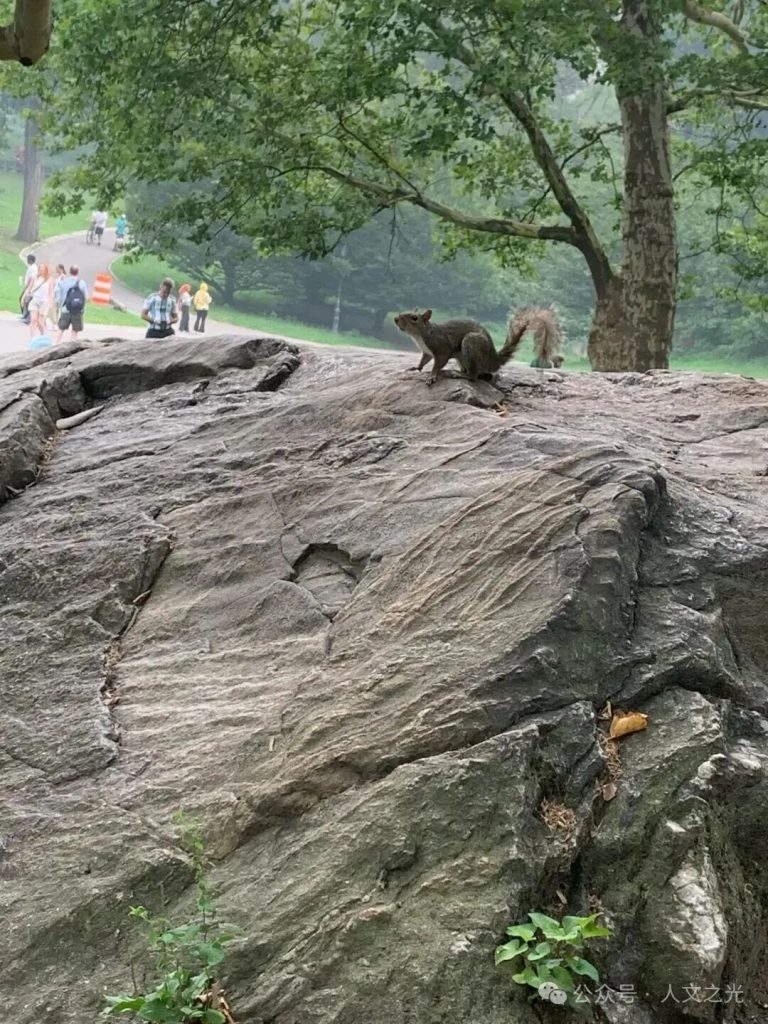
Bonus: A squirrel from Central Park.