ID Mailbox, Cynthia
I. Research Background and Questions
The booming development of social media has given rise to the explosive growth of the “influencer economy.” Platforms such as Xiaohongshu and Douyin, through algorithmic recommendations and user-generated content, have turned numerous niche tourist destinations from “unknown” to “crowded.” Attracted by online content that “plants the seed,” tourists flock to these places, and the surge in foot traffic forces businesses to adjust their operational strategies, ultimately reshaping the destination’s tourism image across business mix, consumer experience, and spatial character.
Existing research has largely focused on the macro-industrial logic and traffic monetisation mechanisms of the influencer economy, lacking field investigations into micro-level interactions and real-world effects. Case studies targeting specific destinations are especially scarce. Taking Guiyang Qingyun Market as its research subject, this paper focuses on the following core question: How does the influencer economy specifically permeate and affect the market’s business strategies, tourist consumption behaviour and experiences, and the functional layout and landscape creation of the market’s physical space?
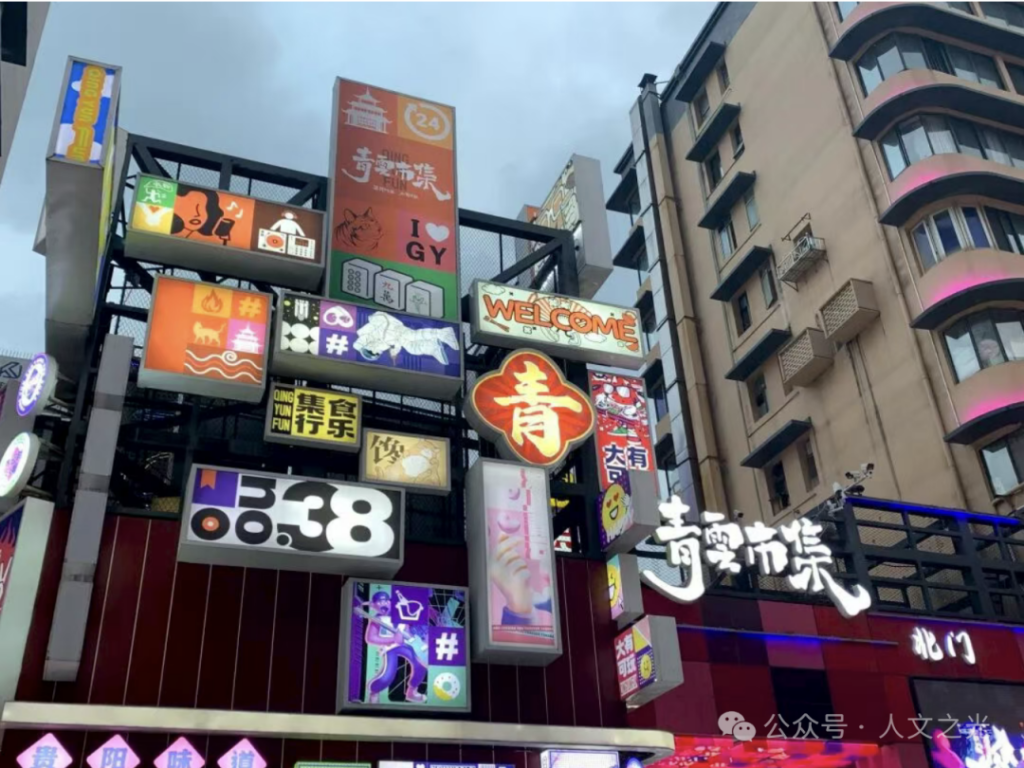
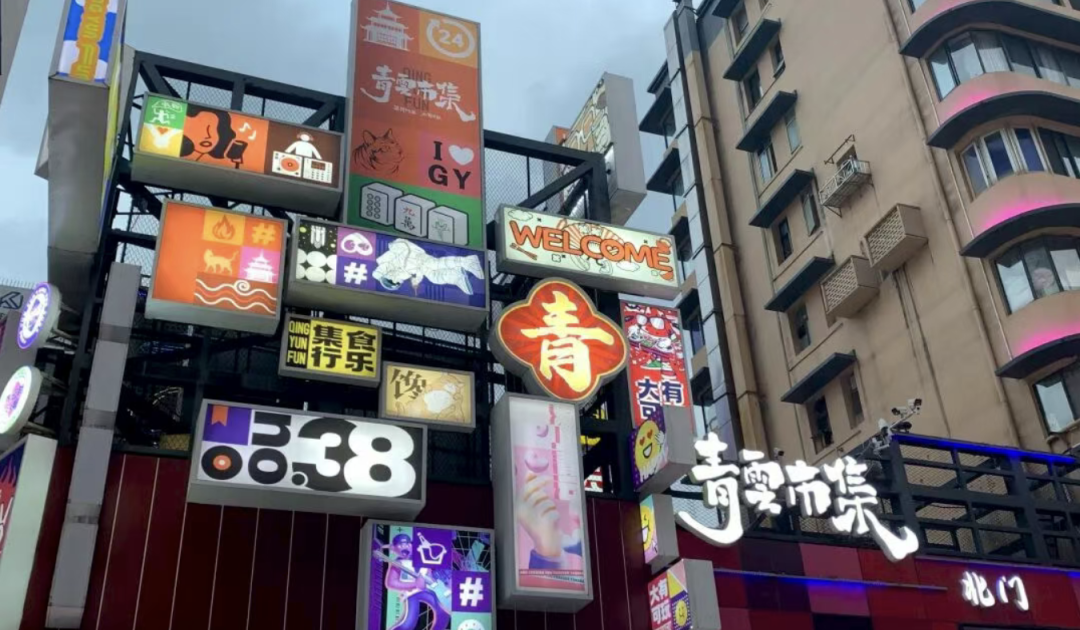
On-site Photos of Qingyun Market
II. Theoretical Framework and Research Methods
This paper understands the “influencer economy” as the concretisation of the “attention economy” in the cultural tourism sector—through the communicative influence of influencers, online traffic is converted into actual purchasing power, achieving a closed-loop realisation of commercial value. In terms of regional image construction, the study adopts Hall’s theory of cultural representation as its analytical framework, arguing that regional images are not simple reflections of objective reality, but rather collections of cultural symbols filtered, processed, and reconstructed by the media—the “regional image” that tourists encounter is essentially the image the media intends to present, rather than the full picture of the destination itself.
The research methodology combines semi-structured interviews with on-site observation. The interviews covered a total of 13 subjects, including 4 shop operators (3 food and beverage outlets and 1 cultural and creative shop) and 9 young tourists aged 16 to 30. The interview records were coded and analysed to extract core characteristics. The research was conducted on a Monday evening (during the college entrance examination period); although it has certain limitations, it holds exploratory value at the qualitative research level.
III. Analysis of Business Strategies on the Shop Side
(1) Deep Embedding of Local Culture
Most shop owners interviewed are local residents, and their product designs are rooted in Guizhou’s traditional food culture—such as potato chips and traditional pan-grilled dishes—emphasising the “authenticity” of ingredient sourcing and production techniques. This cultural self-awareness not only constitutes the core competitiveness of their products but also serves as an important foundation for differentiated operations.
(2) Innovative Adaptations to Cater to Non-Local Tourists
On the basis of tradition, some shops have made adaptive innovations—for example, expanding the classic spicy potato chip range to include new flavours such as tomato and seaweed to appeal to a broader spectrum of non-local tastes. This strategy reflects a dual-track operational logic of “traditional core + modern expression.”
(3) Different Balancing Paths Between Culture and Commerce
The study found that food and beverage shops and cultural and creative shops exhibit notable differences in their “culture-commerce” balancing. Food and beverage shops pay relatively little attention to brand copyright and intellectual property; multiple homogeneous shops may appear within the same commercial space. Cultural and creative shops, by contrast, explicitly emphasise product copyright protection and the standardisation of cultural output, demonstrating a stronger awareness of cultural dissemination. Although the two types of shops pursue different paths, both seek a reasonable balance between cultural sentiment and commercial interests.
IV. Micro-Mechanisms of Tourist Consumption Behaviour
Most tourists interviewed acknowledged that their “knowledge of Qingyun Market” was partly due to promotional content on platforms such as Xiaohongshu. However, regarding consumption decisions at specific shops, tourists tend to “browse as they walk,” making judgments based on their own aesthetic preferences, immediate needs, and on-site perceptions, rather than blindly following influencer recommendations.
This finding suggests that the primary function of influencer content is “traffic attraction”—that is, prompting tourists to visit through visual appeal and information dissemination—but it cannot directly determine their consumption behaviour. The ultimate deciding factor in consumption decisions remains personal experiential judgment and on-site perception, providing important micro-level evidence for understanding the conversion mechanism from “online attention” to “offline purchasing power.”
V. Spatial Creation and Practical Issues
At the spatial level, Qingyun Market exhibits a clear “internet-fication” spatial creation strategy: calligraphic signboards incorporating Guochao elements, LED brand walls, and nighttime lighting effects collectively construct a highly “photogenic” visual scene, significantly enhancing social dissemination.
However, on-site observations also reveal several practical issues. First, there is a tendency towards homogenisation in the design styles of many check-in points—elements such as influencer walls and LED signs appear repeatedly, potentially weakening distinctiveness over the long term. Second, uncivilised behaviours such as smoking and littering by tourists are present at the site, affecting environmental cleanliness and the visiting experience. Third, the market is located adjacent to residential areas, and the glare and noise from nighttime operations cause substantial interference in the daily lives of nearby residents, reflecting the tension between commercial development and community rights.
VI. Value Transmission Closed Loop and Regional Economic Effects
Drawing on the comprehensive investigation, this paper summarises the value transmission path of the influencer economy from online to offline:
Online influencer content → breaks destination stereotypes (e.g., “Guizhou is backward” → “trendy, delicious, niche”) → reshapes tourists’ psychological perceptions → triggers offline consumption behaviour → tourists’ check-in sharing generates secondary dissemination → sustained traffic attraction → drives the development of industry chains such as catering, accommodation, and cultural creativity → promotes regional economic growth.
This closed loop reveals the complete logic of conversion from “attention” to “purchasing power” to “sustained influence” in the influencer economy. It is worth noting that the real quality of the offline experience determines the effectiveness of secondary dissemination, which in turn affects the sustainability of the loop—that is, “word of mouth” plays a critical filtering role in the transmission chain.
VII. Optimisation Suggestions and Research Limitations
Based on the research findings, this paper puts forward three suggestions: First, improve public health and infrastructure to enhance visitor comfort; second, deeply explore Guizhou’s intangible cultural heritage and ethnic cultural elements to build a differentiated cultural tourism content system and avoid homogenised competition; third, reasonably plan business hours and noise control standards to balance commercial development with community quality of life.
In terms of research limitations, this study is constrained by a single observation session and a limited sample size. The interviews were conducted on a Monday evening (during the college entrance examination period), and weekend and holiday visitor flows and operating conditions were not covered; moreover, relying solely on qualitative interviews without quantitative support from long-term sales data and visitor volume makes it difficult to capture seasonal dynamic changes. Future research could combine quantitative data with multi-period observations to enhance the robustness of the conclusions.
VIII. Conclusion
The influencer economy can bring significant traffic effects and short-term economic stimulus to a city. However, the true vitality and long-term development of a city ultimately depend on its unique cultural heritage, the authentic experiences in which tourists can be immersive participants, and its distinctive atmosphere of everyday life. “Turning fleeting internet fame into lasting popularity” is not merely a technical issue, but also a cultural one—only by transforming online attention into offline cultural recognition can sustainable development be achieved in the fiercely competitive cultural tourism landscape.
(This article is based on a presentation by Cynthia Zhou at the UHHC Alliance’s third sharing session. All copyrights belong to the author. In the event of infringement, UHHC and the author will pursue legal liability to the fullest extent.)
The Union of Humanities and History Clubs (UHHC) is an international high school student organisation focused on the humanities—history, literature, art, philosophy, and related interdisciplinary applications (such as economics, business, law, humanities AI, etc.). The alliance currently consists of 13 student clubs and 47 independent members, spanning 15 cities across China (Beijing, Shenzhen, Shanghai, Nanjing, Huizhou, Hong Kong, Shenyang, Dongguan, Nanchang, Qingdao, Zhangjiagang, Xiamen, Hangzhou, Tongling, Suzhou), as well as Diamond Bar, California (USA), Newton Township, Pennsylvania (USA), Toronto, Canada, and Singapore, covering 33 secondary schools.
We believe that the humanistic spirit belongs not only to the great civilisations of the past, but also should shine brightly in the contemporary era. In an age of rapid technological advancement, we hope to inherit and promote the beauty of humanism through intellectual exchange, academic exploration, and cultural practice—so that more people may feel the power of the humanities and join us in exploring the depth and breadth of this world.
For more information, please visit our website: http://www.uhhc.com.cn