Bruce Yu
I. Introduction
The Russo-Japanese War (1904–1905) was the first major conflict in modern history in which an Eastern power comprehensively defeated a European power. It not only reshaped the geopolitical landscape of East Asia but also profoundly shook the existing perceptions of European powers regarding the military capabilities of Asian nations. Many military historians have called it “World War Zero,” as it was the first war of the 20th century to extensively deploy modern weaponry such as steel battleships, quick-firing artillery, and radio communications, serving as a critical strategic and tactical preview for the subsequent First World War.
The Battle of Tsushima (27–28 May 1905) was the most decisive naval engagement of the war. The Russian Second Pacific Squadron, after a gruelling voyage of over 20,000 nautical miles, entered battle with approximately 38 vessels, of which 27 were sunk; the Japanese Combined Fleet lost only three torpedo boats, with a casualty ratio that was extremely lopsided. This outcome not only shocked the global naval community but also aroused intense vigilance and close attention from the British Royal Navy, then the world’s leading naval power.
II. Britain’s Strategic Concerns and Drivers of Reform
From the late 19th to the early 20th century, Britain, as the world’s pre-eminent colonial empire, possessed approximately 33 million square kilometres of colonies and a population of nearly 400 million, with over 40 naval bases distributed across all the world’s time zones. In 1889, Britain passed the Naval Defence Act, establishing the famous “Two-Power Standard”—namely, that the Royal Navy’s comprehensive strength must be no less than the combined strength of the world’s second and third largest navies. This standard fully reflected Britain’s extreme emphasis on maritime supremacy.
However, the outbreak of the Second Boer War (1899–1902) and the Boxer Rebellion (1900–1901) consumed significant British overseas military and financial resources. British decision-makers gradually realised that maintaining such a vast imperial system with its own resources alone was becoming increasingly difficult. To this end, Britain signed the first Anglo-Japanese Alliance with Japan in 1902, positioning Japan as Britain’s strategic pivot in the Far East to help protect British colonial interests in China. As one scholar put it: “The greatest challenge facing Britain at the time was not defeating an enemy, but defending an overstretched empire.”
(Image: The Anglo-Japanese Alliance, 30 January 1902. Diplomatic Archives of the Japanese Ministry of Foreign Affairs)
Against this backdrop, the outbreak of the Russo-Japanese War and the outcome of its naval决战 were by no means a distant regional affair for Britain, but a major issue concerning its global strategic layout.
III. Historiographical Controversy: Re-examining the Extent of the Russo-Japanese War’s Impact
On the actual extent of the Russo-Japanese War’s influence on British naval reform, there has long been disagreement within the historiography:
- Price Bethune argued that the Russo-Japanese War accelerated the Royal Navy’s reform process, but was not the sole factor; rather, it acted as a catalyst amid multiple pressures.
- Julian Corbett, one of Britain’s most influential naval strategic thinkers, emphasised that the core lesson of the Battle of Tsushima was that command of the sea is more fundamental than the direct destruction of enemy fleets.
- Arthur Merriman pointed out that Admiral Fisher’s naval reforms had already begun before the Russo-Japanese War, and that the war only served to accelerate them.
- Nicholas Lambert contended that the primary drivers of British reform were financial pressures and strategic anxiety, rather than specific wartime experiences.
These controversies form the starting point of this article: in which specific technical and theoretical areas did the Russo-Japanese War actually influence the British Navy? And what were the depth and boundaries of this influence?
IV. Innovations in Firepower Systems
The signing of the Anglo-Japanese Alliance provided Britain with an institutional channel for direct observation of the war. Japan allowed British military observers aboard Japanese vessels, thereby enabling Britain to obtain valuable first-hand data from the Battle of Tsushima.
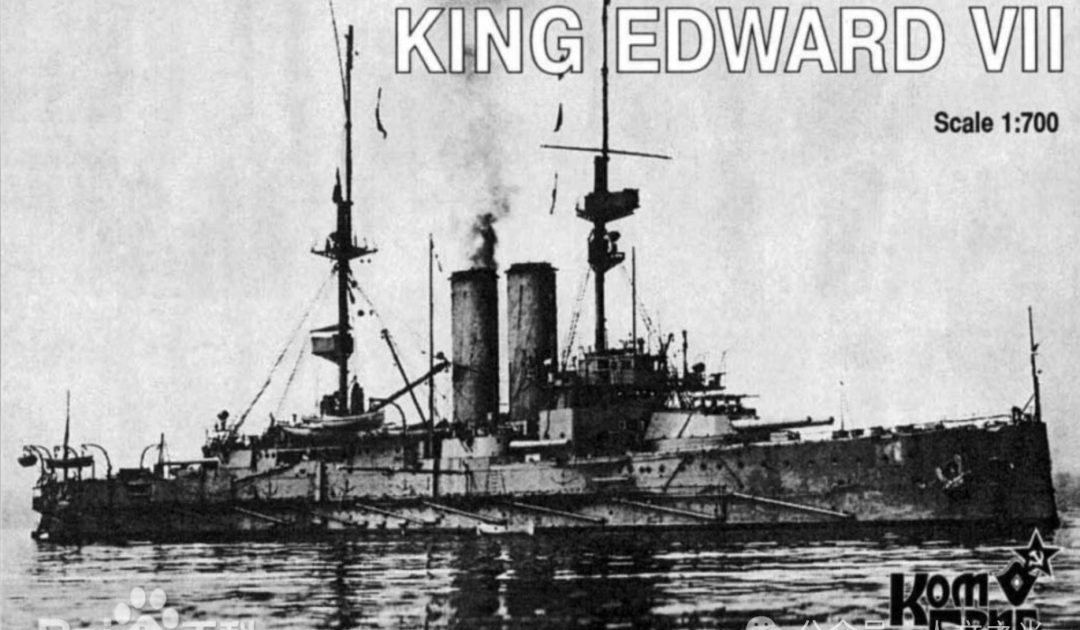
(Image: British King Edward VII-class pre-dreadnought battleship)
Before the war, Britain’s King Edward VII-class pre-dreadnoughts employed a mixed-calibre armament design—equipped with 12-inch main guns, 9.2-inch intermediate calibre guns, and 6-inch secondary guns. The theoretical basis of this design was that, in close-range naval combat, the density of fire per unit of time was the decisive factor. However, the actual engagement distance at the Battle of Tsushima reached 6,000 to 8,000 metres, and showed a continuing trend towards greater distances. The 6-inch secondary guns had an effective range of only about 6,000 metres, rendering them virtually useless at long ranges.
British observers concluded that armour-piercing capability and long-range accuracy of heavy-calibre guns were the core determinants of naval victory. This understanding was directly reflected in the firepower design of the Dreadnought—abandoning the previous complex mixed-calibre schemes and uniformly equipping ten 12-inch main guns, greatly enhancing long-range firepower consistency and destructive efficiency.
V. Evolution of Fire Control Systems
On traditional mixed-calibre battleships, each calibre of gun was aimed and fired independently. Because shells of different calibres had different flight times and differing splash heights upon impact, observers found it extremely difficult to distinguish the fall of shot from each gun during salvoes, thus preventing effective correction of firing parameters. This problem severely constrained hit rates in long-range engagements.
In the Battle of Tsushima, the Japanese fleet had already begun experimenting with unified fire control management and salvo tactics—all main guns fired simultaneously, with concentrated fall of shot that was easy to observe and correct. Britain drew on this experience and adopted centralised fire control systems on the Dreadnought, standardising gun calibres to eliminate ballistic differences, thereby greatly improving the efficiency of firing corrections and hit accuracy.
VI. The Leap in Mobility
In the Battle of Tsushima, the Japanese Combined Fleet successfully employed the “T-crossing” tactic in actual combat for the first time—one fleet deployed on a horizontal axis, bringing all its broadside guns to bear on the head of the enemy column, while the enemy could only reply with its forward main guns. However, executing the T-crossing required one’s fleet to seize an advantageous position at extremely high speed before the engagement; during this process, the flank would be exposed to enemy fire, making speed a critical prerequisite.
(Image: Admiral Tōgō Heihachirō commanding the battle from the Mikasa during the Battle of Tsushima; from right to left: Akiyama Saneyuki, Tōgō Heihachirō, Katō Tomosaburō)
Operational data shows that the Japanese fleet achieved a speed of approximately 15 knots on the day of the decisive battle, while the Russian fleet managed only about 9 knots. Although both fleets’ designed top speeds were around 18 knots, the actual speed differential was enormous. Japan was thus able to completely control the tempo of the battle, deciding when to engage, when to disengage, and when to launch the final assault—effectively mastering the strategic initiative on the battlefield.
Inspired by this, Britain pushed the speed of its battleships and subsequent designs to unprecedented levels. The Majestic-class battleships, launched in 1895, had a top speed of 17 knots; the 1906 Dreadnought achieved 21 knots; and the 1908 Invincible-class battlecruisers reached 25 to 26 knots. Speed had been elevated from a secondary tactical element to a core strategic indicator.
(Image: Invincible-class battlecruiser)
VII. The Birth of the Dreadnought: Catalysed, Not Created
In terms of chronology, Fisher’s concept of the Dreadnought—”all-big-gun, high speed, centralised fire control”—had already taken shape between 1902 and 1904, and the Naval Reform Committee had formally initiated relevant discussions in 1904. Therefore, the Battle of Tsushima did not “create” the Dreadnought.
The true significance of the Battle of Tsushima lay in this: it provided irrefutable combat results that comprehensively validated the core tenets long upheld by the reformists, effectively suppressing the opposition of conservatives, and providing solid political support and public legitimacy for Fisher’s reform programme. In other words, the Russo-Japanese War did not furnish new design concepts, but rather cleared the institutional obstacles for the implementation of existing ones.
VIII. Conclusion
Based on the above analysis, this article arrives at the following three core conclusions:
First, the greatest contribution of the Russo-Japanese War to the British Royal Navy was the provision of verifiable combat experience, which endowed Britain’s long-gestating strategic and technical concepts with empirical grounding and political legitimacy—rather than creating an entirely new theoretical framework.
Second, the Battle of Tsushima confirmed four major trends in modern naval warfare—heavy calibre armament, centralised fire control, high speed, and fleet coordination. These concepts not only dominated naval construction for decades thereafter, but some of their principles continue to hold reference value to this day.
Third, Britain’s absorption of lessons from the Russo-Japanese War was distinctly “selective.” It focused heavily on heavy calibre guns and speed, yet relatively neglected emerging elements such as submarines, mines, and radio coordination. This selective learning would reveal far-reaching consequences during the First World War.
War itself does not automatically produce conclusions; rather, it is observers who “interpret” and “select” experiences through existing theoretical frameworks. This reflection applies not only to naval history, but also to the broader study of military transformation and organisational learning.
(This article is based on a presentation by Bruce Yu at the UHHC Alliance’s third sharing session. Edited by Peter Tian of the UHHC Operations Office. The accompanying images are sourced from the internet; if any infringement exists, we will remove them immediately. All copyrights belong to the author. In the event of infringement, UHHC and the author will pursue legal liability to the fullest extent.)
About Us
The Union of Humanities and History Clubs (UHHC) is an international high school student organisation focused on the humanities—history, literature, art, philosophy, and related interdisciplinary applications (such as economics, business, law, humanities AI, etc.). The alliance currently consists of 13 student clubs and 47 independent members, spanning 15 cities across China (Beijing, Shenzhen, Shanghai, Nanjing, Huizhou, Hong Kong, Shenyang, Dongguan, Nanchang, Qingdao, Zhangjiagang, Xiamen, Hangzhou, Tongling, Suzhou), as well as Diamond Bar, California (USA), Newton Township, Pennsylvania (USA), Toronto, Canada, and Singapore, covering 33 secondary schools.
We believe that the humanistic spirit belongs not only to the great civilisations of the past, but also should shine brightly in the contemporary era. In an age of rapid technological advancement, we hope to inherit and promote the beauty of humanism through intellectual exchange, academic exploration, and cultural practice—so that more people may feel the power of the humanities and join us in exploring the depth and breadth of this world.
For more information, please visit our website: http://www.uhhc.com.cn